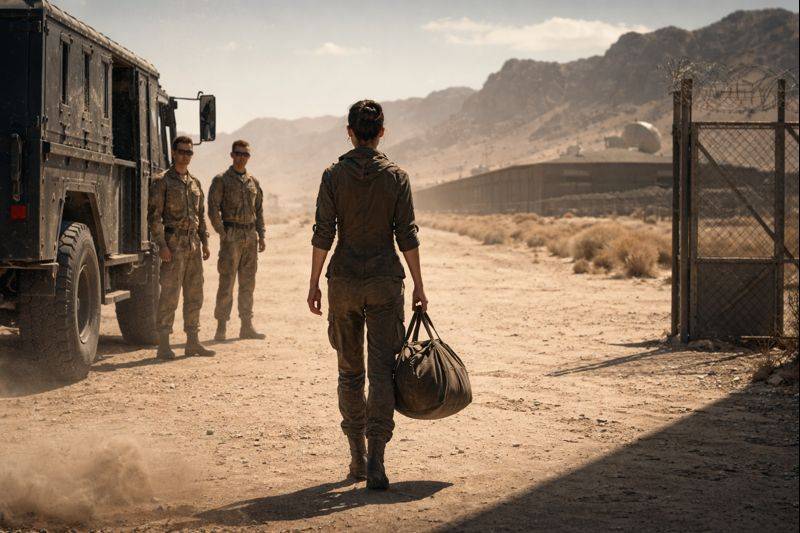
The dust of the Nevada desert settled on everything at Black Rock Range, a fine gritty powder that worked its way into machinery and dispositions alike. It coated the matte black transport that deposited Vance at the main gate, a solitary figure against the vast indifferent landscape. The guards, young men with crisp uniforms and the easy confidence of those who held small measures of power, glanced at her simple fatigues and her single duffel bag with practiced disinterest. Her paperwork identified her as a technical consultant, a title vague enough to mean anything and to them specific enough to mean nothing. One of them grunted, jerking a thumb toward the sprawling windowless hangar that dominated the compound. “In there, don’t wander.” She gave a single, barely perceptible nod and walked past them, her footsteps making no sound on the crushed gravel.
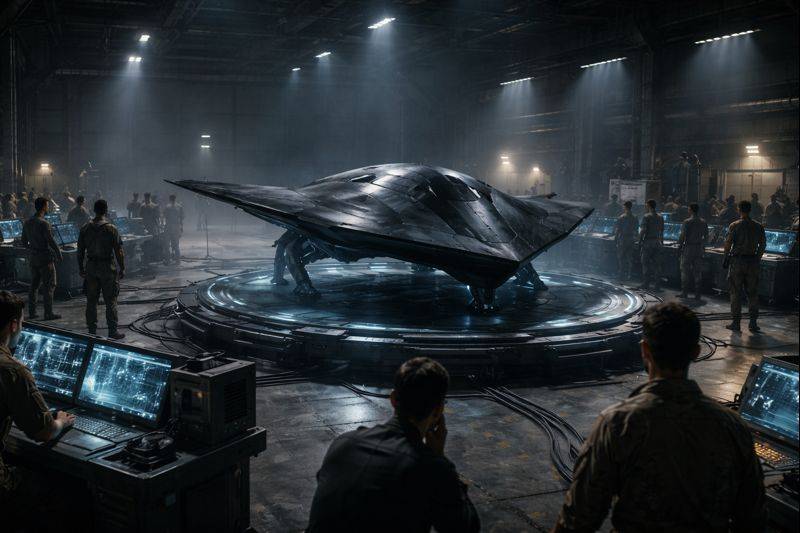
The air inside the hangar was a stark contrast to the oppressive heat outside. It was cold, sterile, and thick with the electric hum of advanced technology and the palpable weight of frustration. A team of engineers and pilots, mostly men younger than her thirties, were gathered around a central command console, their voices sharp with disagreement. They were the nation’s best, called from elite universities and top flight squadrons, and their collective arrogance was a tangible force field. No one noticed her entry. She was just another shadow in a place built of them.
She found an unoccupied corner near a secondary power conduit, set down her bag, and began to watch. Her stillness was an anomaly in the constant, agitated motion of the room. It was not the stillness of timidity, but of patience, the deep ingrained discipline of a predator waiting for the hunt to begin. Her gaze drifted to the object of their consternation, resting on a raised platform in the center of the hangar. The Acaron drone. It was less an aircraft and more a shard of obsidian given flight. All sharp angles and non-reflective surfaces designed to devour radar signals. It was a technological marvel, the supposed future of untraceable reconnaissance, and it was a complete and utter failure.
Colonel Madson, the base commander, finally found the time to address the consultant he had been told to expect. He was a man shaped by the rigid certainties of command, his posture a testament to a career spent giving orders and having them followed. He held her personnel file in his hand, though it was less a file and more a single sheet of paper, thin and insulting in its brevity. Most of it was blacked out with thick, unapologetic redactions. “Vance,” he said, his voice clipped, not bothering to make eye contact as he scanned the page. “Says here you have some field experience with remote systems.” The slight pause he injected into the phrase dripped with condescension.
He looked up, his eyes sweeping over her unassuming frame, taking in the lack of rank insignia, the plainness of her attire. He saw nothing of value. “We have pilots with thousands of hours in the most advanced fighters on the planet. We have engineers with doctorates from Caltech and MIT. Their resumes are somewhat more substantial than this.” He let the single page flutter from his fingers onto the desk between them.
Lieutenant Hayes, the lead test pilot, stood nearby, a smirk playing on his lips. He was young, handsome, and carried the unshakable self-assurance of a man who had never truly failed at anything. He saw Vance as an administrative burden. Another box for the colonel to check. “With all due respect, Colonel,” Hayes chimed in, his tone making it clear no respect was intended. “We’re neck deep in diagnostics. We don’t really have time to babysit.”
Madson gave a slight nod, his gaze returning to Vance, cold and dismissive. “So, I’ll ask you directly. What exactly do you believe you can contribute to the Acaron program?” The question was a challenge, a demand for justification she was not expected to provide. Vance’s eyes were steady, her expression unreadable. She did not look at the colonel’s overt disdain or the lieutenant’s smug grin. Her focus was on the drone, visible through the reinforced glass of Madson’s office.
“I’m here to observe the system,” she stated, her voice quiet but firm, carrying no hint of defiance or apology. It was a simple declaration of fact. The simplicity of it seemed to irritate Madson more than an argument would have. He waved a hand, a gesture of finality. “Fine. Observe. Just stay out of the way of the people who are actually doing the work.” He turned his attention back to Hayes, the consultant already forgotten. “Let’s run the simulation again, Lieutenant. And this time, try not to fry the interface.” Hayes shot Vance a parting glance of victorious pity before following the colonel out.
Vance remained for a moment in the sterile office, her reflection a faint ghost in the polished surface of the desk before she turned and walked back to her corner in the hangar, content to be dismissed. For the next three days, Vance became part of the hangar’s architecture. She stood in the periphery, a silent observer, her presence so unobtrusive that the team soon forgot she was there. They took to calling her “the scribe” or “the shadow” in their infrequent mocking asides, noting the small leather-bound notebook she carried. She made meticulous entries, but she was not watching the pilots. She was watching the data.
While the engineers focused on the software crashes and the pilots complained about the violent neural feedback, Vance watched the energy schematics. She saw what they missed: infinitesimal fluctuations in the Acaron’s power distribution, subtle energy spikes in the drone’s biomimetic processors that corresponded not to pilot input, but to atmospheric variables. The system wasn’t just unstable; it was sensitive, responding to the world around it in ways its creators had never intended. They were trying to cage a wild animal, and it was fighting back.
Her gaze would often settle on the drone itself. Hayes and his team treated it like a recalcitrant machine, a stubborn tool to be bent to their will. They spoke of it with frustration and anger. Vance saw something else. She saw in its sleek, dark fuselage not an object, but a dormant partner. Its silence seemed to her not one of malfunction, but of waiting. She understood its language better than the men who had built it.
During a lull in the testing, as a flustered engineer cursed at a screen of corrupted code, Vance’s hand unconsciously drifted to her left wrist. She pushed back the simple black band of her watch, revealing for a brief second a faded tattoo on the delicate skin of her inner arm. It was a complex stylized design, a spectral ghost-like figure woven together with the silhouette of a single raven’s feather. It was an old symbol from a life no one here knew she had lived. A marker of a unit that officially no longer existed. A memory of silence and shadow, of missions that were never spoken of and operatives who were never seen. She pulled the watch back into place just as Lieutenant Hayes strode past, shaking his head.
“Whole damn program’s a bust,” he muttered to another pilot. “You can’t fly a ghost.” Vance watched him go, a flicker of something ancient and knowing in her eyes. He had no idea how right he was. The problem wasn’t that the Acaron was a ghost. The problem was that none of them knew how to speak to one.
The pressure mounted with the inevitability of a coming storm. A four-star general from the Pentagon was arriving for a final go-or-no-go demonstration. The Acaron program, billions of dollars over budget and years behind schedule, was on the chopping block. Failure was not an option. It was an execution. The hangar, once merely frustrated, was now a tinderbox of raw nerves and frayed tempers.
Colonel Madson’s face was a grim mask of controlled anxiety, the fate of his command hanging on the performance of a single, unreliable machine. Lieutenant Hayes was selected for the demonstration flight. His usual swagger was still present, but it was brittle, a thin veneer over a core of palpable tension. He strapped himself into the pilot’s chair, the neural interface headset gleaming under the harsh hangar lights. “I’ve got this,” he said, his voice a little too loud in the cavernous space. No one looked convinced.
The initial launch sequence was flawless. The Acaron lifted from its platform with an eerie grace, its engines emitting a low, almost subsonic hum that was more of a feeling in the chest than a sound. On the main viewscreen, the drone’s perspective showed it climbing smoothly into the stark blue of the desert sky. A collective hopeful breath was held in the control room.
The mission was a complex reconnaissance run through a network of narrow, winding canyons known as the Labyrinth. A test designed to push its maneuverability to the absolute limit. For five minutes, everything was perfect. Hayes, growing confident, pushed the drone faster, weaving through the rock formations with aggressive precision. Then it happened. A flicker on the data stream. A single, almost imperceptible tremor in the video feed.
Alarms, soft at first, then rising to a frantic, piercing shriek, began to blare through the control room. “Feedback spike! I’m losing the link!” Hayes yelled, his face suddenly ashen. His hands clenched on the controls were useless. The connection was neural. The feedback was pouring directly into his brain. On the screen, the Acaron pitched violently, its graceful flight devolving into an uncontrolled death spiral. It careened toward a sheer canyon wall, the granite face rushing up to meet it.
Panic erupted. Engineers shouted contradictory instructions. Technicians scrambled over consoles, trying to isolate the problem. Madson stood frozen, watching billions of dollars and his entire career about to be pulverized into dust and carbon fiber against a cliffside. In the heart of the chaos, while every eye was fixed on the screens predicting imminent disaster, Vance moved.
She did not run. She walked with a calm, deliberate purpose that was an island of serenity in the sea of panic. She crossed the room to a secondary maintenance terminal, a dusty, forgotten console that was rarely powered on. No one noticed her. Her fingers met the keypad and a silent storm of activity bloomed on the small amber screen. Her hands moved with a fluid, blinding speed. Her fingers not just typing, but dancing across the keys.
She wasn’t fighting the system or trying to override it. She was communing with it, inputting lines of code that were less like commands and more like a soothing whisper in the machine’s own native language. With surgical precision, she identified the cascading error that had sent the neural feedback into a fatal loop. She didn’t just block it. She isolated the corrupted data packet, purged it from the system’s short-term memory, and rerouted the Acaron’s primary flight control functions to her own terminal, completely bypassing Hayes’s overloaded and now useless interface. The entire process took less than four seconds.
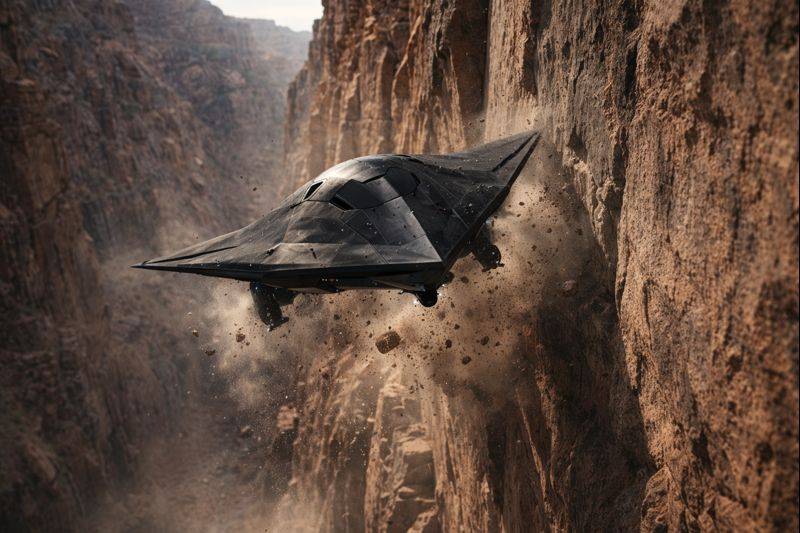
On the main viewscreen, the effect was instantaneous and breathtaking. One moment, the Acaron was plummeting towards certain destruction. The next, it stopped. It simply stopped, hovering a hundred feet from the canyon wall as motionless as a hummingbird. The frantic alarms cut out, plunging the control room into a stunning, profound silence.
For a moment, the drone just hung there, a black spectre against the red rock. Then, with a liquid grace that none of its designers had ever thought possible, it executed a perfect slow 180° pirouette. It leveled off and resumed its mission flight path down the center of the canyon. As if the entire incident had been a planned, elegant maneuver.
The room remained silent. The only sound the quiet, steady hum of the servers and the distant, almost imperceptible whine of the drone’s engines from the speakers. Vance took one step back from the terminal, her hands falling to her sides. Her work was done. She melted back into the shadows she had emerged from, her expression as calm and unreadable as ever.
The silence in the control room stretched for an eternity, thick with disbelief and awe. It was finally shattered by the sharp voice of the visiting general’s aide, a young, sharp-eyed major. “Control, what in God’s name was that? Who has the aircraft?” Every head in the room from Colonel Madson to the lowest ranking technician swiveled as one, their gazes searching and finally landing on the lone still figure of Vance standing quietly by the forgotten maintenance terminal.
Lieutenant Hayes, now disconnected from the neural interface, sat slumped in his chair, his face pale and beaded with sweat. He stared at her, his arrogance completely stripped away, replaced by a raw, uncomprehending wonder. “How…” he stammered, the single word all he could manage.
Madson approached her, his steps slow and deliberate. The institutional certainty that had defined him was gone, replaced by the deep-seated confusion of a man who has just witnessed the impossible. “Ms. Vance,” he said, his voice low and devoid of its earlier condescension. “Explain what you just did.” Her gaze remained fixed on the main screen where the Acaron was now performing its reconnaissance patterns with a flawless otherworldly grace.
“The neurolink has a sympathetic feedback filter,” she said, her voice even and calm. “Lieutenant Hayes was pushing the system too hard. He was fighting it. It created a resonance cascade.” She paused, then added, “You were trying to command it. It needs to be guided.” Her simple explanation hung in the air, its profound implications slowly dawning on the engineers who had spent years trying to bludgeon the machine into submission. It wasn’t a problem of code. It was a problem of philosophy.
Near the back of the room, a grizzled master sergeant, a man who had been in uniform since before most of the pilots were born, squinted, his eyes narrowing as a distant memory surfaced. “Ghost Recon,” he muttered, the words barely audible, spoken more to himself than to anyone else. “Heard they had a whisper pilot back in the day. Someone who could sync with prototype tech nobody else could touch. They said she could fly anything with a circuit board.” He looked directly at Vance. “Call sign was Echo.”
The name dropped into the charged silence of the room like a stone into a still pond. Vance did not acknowledge the name. She did not react at all, but for a brief, unguarded moment, a flicker of something ancient and deeply weary passed through her eyes. The ghost of a past she had thought long buried.
The visiting general, a man not easily impressed, was now intensely interested. The near disaster had transformed into a stunning display of unprecedented capability. The program was not dead. It was suddenly the most promising project in the entire defense portfolio. But he needed more than a single miraculous save.
The next morning, a new trial was ordered, unscheduled and designed to be brutally difficult. The objective: locate a small, mobile, electronically shielded target vehicle hidden somewhere within a 500-square-mile sector of the test range, an area deliberately flooded with decoy signals and electronic countermeasures. It was a needle-in-a-haystack search in a field of magnetic chaff.
This time there was no discussion about who would pilot the drone. Colonel Madson approached Vance not with an order but with a question. “Ms. Vance,” he said, his tone now one of profound deference. “Will you fly the Acaron for this trial?” She responded with a single simple nod.
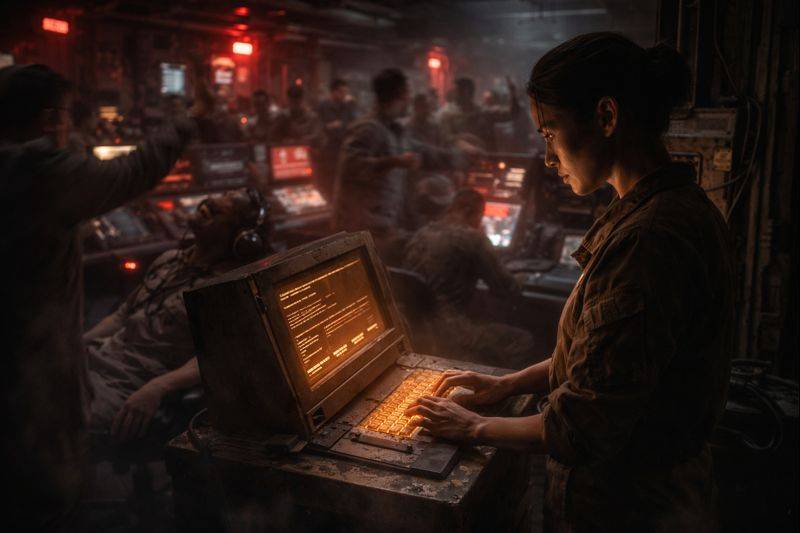
The atmosphere in the control room was transformed. The swagger and nervous energy of the previous day were gone, replaced by a tense, focused silence. Every person in the room was an observer, a student waiting for a master class to begin. Vance sat at the primary command console, the chair that had overwhelmed Hayes seeming to fit her perfectly. She slid the neural interface headset on and initiated the link.
The data streams on the monitors were not the jagged, chaotic spikes they had been with Hayes. They were serene flowing lines, a calm, steady rhythm like a sleeping heartbeat. The connection was seamless, symbiotic. She launched the Acaron, but her technique was utterly different. She didn’t force it into the sky. She eased it into the air, letting it catch the morning thermals, its movements economical and fluid. She wasn’t piloting a machine. She was wearing it.
She flew for hours, ignoring the cacophony of electronic decoys that had been designed to fool the drone’s sensors. The other pilots watched, mesmerized. She wasn’t just looking through a camera. She was using the Acaron as an extension of her own senses. She felt the subtle shifts in air temperature, saw the faint traces of disturbed earth that nature would not have made, perceived the unnatural patterns in the foliage. She was thinking not like a pilot, but like a hunter.
Her consciousness spread across miles of desert, sifting through reality itself for the single discordant note of her prey. The engineers watched their own data streams, finally understanding. The drone wasn’t just a machine. In her hands, it was alive. Hours bled into one another.
The sun reached its zenith and began its slow descent toward the western mountains. The initial tense optimism in the control room had faded into a quiet, respectful resignation. The task was, as designed, impossible. The general was beginning to look impatient. Even Madson’s newfound faith was starting to waver. The target was simply gone, swallowed by the vast, electronically noisy desert.
Then, cutting through the low hum of the servers, her voice came, calm and clear. “Target acquired.” On the main screen, the view zoomed in with impossible speed and clarity. It bypassed a cluster of decoy heat signatures and focused on a small rocky overhang miles away. The image stabilized, piercing through the camouflage netting. There, tucked perfectly into the shadows, was the target vehicle, completely invisible to any standard optical or thermal sensor.
A wave of stunned applause broke the silence. While the general and his aides celebrated the astonishing success, a priority message alert flashed on Colonel Madson’s personal terminal. It was a Pentagon-level eyes-only encrypted communiqué, a direct response to his urgent query for the unredacted file of technical consultant Vance. With trembling hands, he entered his credentials. The file opened.
It was still almost entirely blacked out, but a few lines had been cleared for his security level. Subject: Vance, Ela M. Former Unit: Joint Special Operations Command, Task Force 7. Designation: Ghost Recon (Officially Disbanded). Mission History: Classified. Notable Skill Set: Specialist in Prototype Neural Interface Piloting, Deep Infiltration Assets. Last Known Operation: Nightfall. Status: Sole Survivor.
As Madson stared at the words, absorbing the earth-shattering implications, a figure moved to the center of the control room. It was the general’s aide, the young major. He was no longer looking at the screen, but was staring directly at Vance, his face a mask of utter disbelief and dawning reverence. “Echo,” he asked, his voice cracking with emotion.
He was older now, but the scar over his left eye was unmistakable. He had been a junior intelligence analyst attached to her last mission, a terrified lieutenant who had listened to the comms as an entire legendary unit was wiped out. “My god,” he whispered loud enough for the entire room to hear. “It’s you. We all thought you were dead.”
The control room went absolutely still. The whispers about Ghost Recon, the myth of the whisper pilot, the legend of Operation Nightfall—it all coalesced around the quiet woman in the pilot’s chair. They were not in the room with a consultant. They were in the room with a ghost.
The major, who was in fact a full colonel and the general’s chief of staff, straightened his shoulders. He drew himself up to his full height, and with a motion so sharp it seemed to crack the air, he rendered a perfect formal salute. It was not the casual salute for a superior officer. It was a gesture of profound, almost reverent respect, the kind reserved for fallen heroes and living legends. It was a salute for the soldier he thought had died in the darkness years ago. The sole operator who had kept transmitting long after the rest of her team had gone silent. He was saluting Echo.
One by one, inspired by his gesture, the other uniformed personnel in the room followed suit. Lieutenant Hayes, humbled and awestruck, rose from his chair and brought his hand to his brow. The grizzled master sergeant stood at attention, his salute as steady as the rock of the mountains outside. The young airmen, the seasoned engineers, even the civilian contractors—they all stood, their movements unified in a silent, powerful tribute.

Finally, Colonel Madson, the institutional arrogance he once wore now completely stripped away, slowly raised his own hand in salute. They were no longer acknowledging the woman who had saved their program. They were honoring the ghost who had walked out of the pages of myth and into their lives. They were recognizing the last member of Ghost Recon.
Vance slowly disconnected from the neural interface. She turned in her chair, her gaze sweeping over the room full of saluting figures. Her expression remained unreadable, a calm sea over unfathomable depths. But for the first time, the deep abiding weariness in her eyes was plain to see. She offered them no words of explanation, no speech about her past, no acknowledgement of their shock. She simply gave a single slow nod of her head. It was a small gesture, almost imperceptible, but it was enough. It was an acceptance, a shared understanding that some things are honored best by silence.
As the desert sunset bled purple and orange across the horizon, casting long, dramatic shadows from the hangar doors, Vance stood alone with the Acaron. The drone was powered down, its sleek black shell cooled to the touch. She rested a palm against its fuselage, a silent communion between pilot and partner, a moment of quiet thanks.
The base had changed. The personnel who had once ignored or mocked her now gave her a wide, respectful berth. Their gazes were a mixture of awe and a healthy amount of fear. They spoke in hushed tones when she passed, as if afraid a normal volume would cause her to dissipate back into the ether from which she had come.
Colonel Madson approached her, his footsteps hesitant on the concrete floor. He held out the small, worn, leather-bound notebook she had left on the console. “You forgot this,” he said, his voice quiet, stripped of all its former authority. He was no longer a commander addressing a subordinate. He was a man speaking to something far outside his comprehension.
She took the notebook from him without a word, her fingers brushing his, and the brief contact seemed to carry an electric charge of history and loss. As she turned to leave, her fatigue jacket sleeve rode up her arm by a fraction of an inch, just enough for Madson to see it clearly in the dimming light. The tattoo on her inner wrist, the ghost intertwined with the raven’s feather, the symbol of her unit. He finally truly understood.
She wasn’t just a pilot. She was a remnant. She was the final living echo of a promise made in the shadows. She was proof that even when a mission is declared a catastrophic failure, even when a legendary unit is wiped from the official records, one of them might still be out there moving silently, relentlessly toward the objective.
The massive hangar door rumbled open to let her out and slid shut behind her, leaving Madson alone in the cavernous space with the cooling drone. The air was still, but it hummed with the charge of her presence, a lingering testament to the woman they had so casually dismissed. A ghost had walked among them, completed her task, and faded back into the dusk.