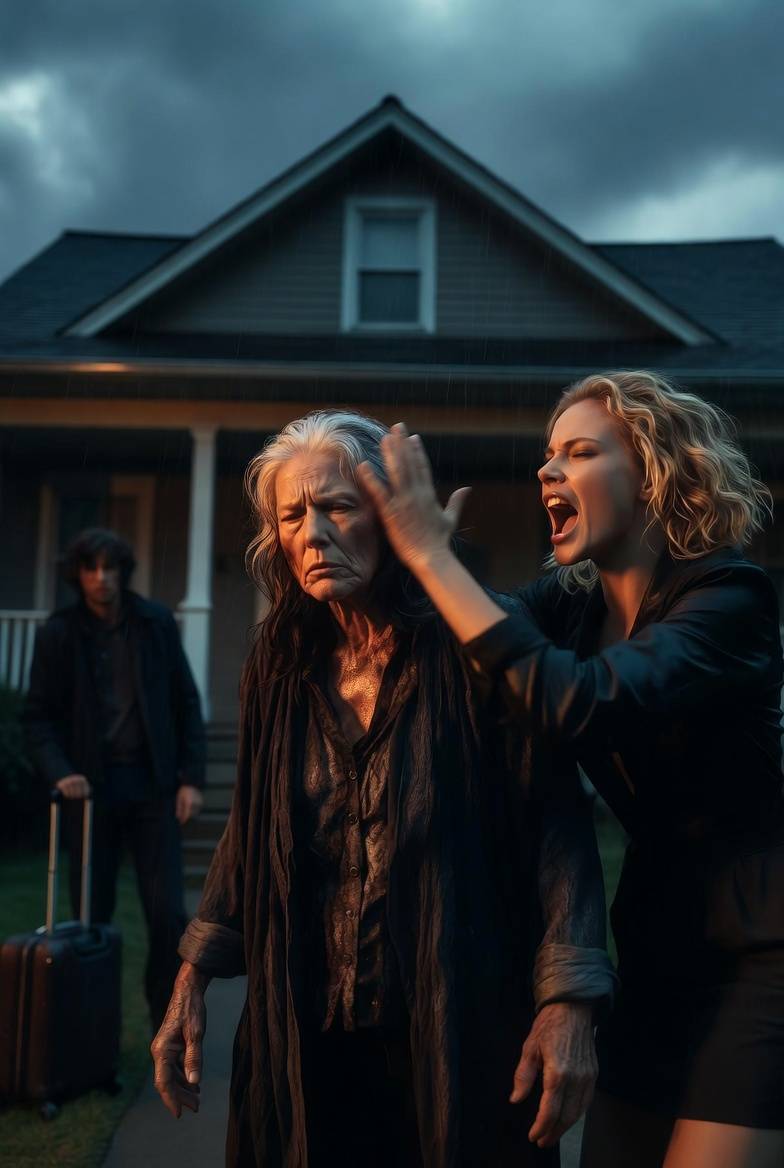
The slap landed like a gunshot in the still afternoon air. My cheek burned, but the real heat was deeper, somewhere behind my ribs where a mother’s heart is supposed to stay soft. I tasted copper. Not from blood. From the metallic tang of every memory I was swallowing down.
Terrence still hadn’t moved. My son—thirty-eight years old, broad-shouldered from the construction jobs he used to take before the “easier life” with Lennox—stood frozen on my front walk like a man watching a train wreck he’d helped engineer. His eyes flicked to the red mark blooming across my face, then dropped to the cracked concrete. The same concrete we’d poured together the summer he turned sixteen, when I told him real men built things that lasted.
Lennox’s designer heels clicked triumphantly as she stepped back. Her perfume—something expensive and sharp, like citrus left too long in the sun—wafted over me. “There. Now maybe you’ll listen.” She tossed her highlighted hair, the kind of calculated movement meant for Instagram stories, not real ruin. “We’re family, Diane. Blood. You don’t turn away blood.”
I looked past her at the two battered suitcases. One zipper had split, vomiting out a silk scarf and what looked like a half-empty bottle of Chanel. Six hundred and twenty thousand dollars. The number pulsed in my head like a dying heartbeat. I saw the house on Maple Ridge again—the one I’d co-signed for, the one we’d fixed up on weekends with cheap pizza and cheaper wine. Terrence laughing as he painted the nursery they never used. Lennox scrolling on her phone in the corner, already bored.
I finally spoke, my voice low and steady, the way you talk when the ground is cracking under your feet and you refuse to fall. “Blood doesn’t write blank checks, Lennox. And it sure as hell doesn’t slap the hand that once held it.”
Neighbors were gathering now. Mrs. Alvarez from across the street clutched her watering can like a shield. Old Mr. Hargrove pretended to check his mailbox but leaned in closer. Good. Let them see. Let the whole street witness what my son had become.
Terrence finally found his voice, cracked and small. “Mom… please. Just a few weeks. Until we figure things out.”
I studied him. The defeated slump of his shoulders. The way his wedding ring—still gleaming, paid for with my money—caught the light. Then I looked at Lennox, her arms crossed, lips pressed in that perfect line of righteous fury. She believed her own story. That much was clear. People like her always did.
I stepped back inside, the screen door creaking like an old bone. “The answer is still no.”
The door clicked shut. I leaned against it, heart hammering, and listened to the explosion outside. Lennox’s voice rose to a siren pitch, painting me as the villain for the entire block. Terrence’s mumbled protests barely registered. I walked to the living room, past the faded photos on the mantel: Terrence at his high school graduation, me in a cheap dress smiling like the future was something you could hold. I opened the filing cabinet in the corner—the one that had survived two floods and one divorce—and pulled out the folder.
The original purchase paperwork. And clipped to it, the overlooked document. A second trust deed I’d insisted on when I helped buy the house, back when Terrence was still the boy who promised to take care of me one day. It gave me a quiet, legal claim. Not enough to seize everything, but enough to open doors neither of them wanted opened.
I sat at the kitchen table as the shouting outside faded into car doors slamming. My hands didn’t shake. Not yet.
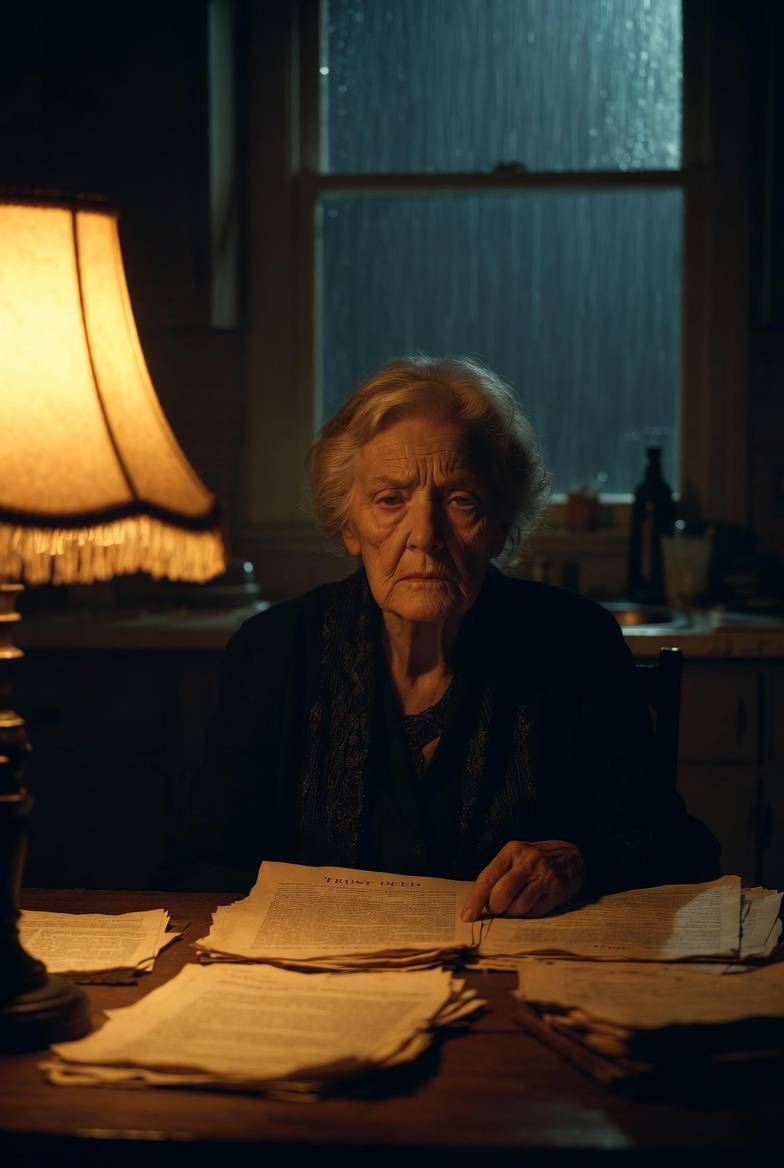
That night the house felt too big, too quiet. I poured a glass of the cheap merlot I kept for nights like this and stared at the document under the warm lamplight. The legal language was dry, but to me it read like a love letter from the woman I used to be—the single mother who worked double shifts at the hospital billing office so her son could have more than she did. I had trusted him. That was my first mistake.
The doorbell rang at 11:17 p.m. I knew who it was before I looked through the peephole. Terrence, alone, shoulders hunched against the chill. No Lennox. He looked smaller in the porch light.
I opened the door but didn’t step aside. “She send you to do the pleading?”
He rubbed the back of his neck—the same gesture he’d used since he was seven and got caught stealing cookies. “She’s at a hotel. Using the last of the credit card. Mom… I’m sorry about the slap. She’s just scared. We both are.”
Scared. The word landed wrong. I stepped out onto the porch and closed the door behind me. The night smelled of cut grass and distant rain. “Scared people don’t slap the person they’re begging from, Terrence. Scared people don’t blow through six hundred and twenty thousand dollars on jewelry and ‘business opportunities’ that were obviously scams.”
He flinched. “It wasn’t all her. I said yes to things. I wanted… I wanted her to be happy. You don’t know what it’s like, living with someone who needs things to feel alive.”
I laughed once, short and bitter. The sound surprised even me. “I raised you alone after your father left with the grocery money and a note that said ‘sorry.’ I know exactly what it’s like. Difference is, I never took it out on anyone else.”
Silence stretched between us. Somewhere down the block, a dog barked. Terrence’s eyes glistened, but I couldn’t tell if it was shame or self-pity. Maybe both.
“I still have the paperwork,” I said quietly. “The trust deed. I can open an investigation into how the sale proceeds were handled. Trace every transaction.”
His face went pale. “Mom… that would ruin us. Lennox’s friend—the one with the deal—she’s connected. There could be… legal stuff. Taxes. Worse.”
“Worse than slapping your mother in public? Worse than watching your son stand there while it happened?”
He had no answer. I saw the boy then, buried under layers of bad choices and easier lies. The one who used to fall asleep on my lap during thunderstorms. My chest ached with a pain so sharp it felt physical.
“Go to the hotel, Terrence. Figure out who you want to be when the money’s really gone. Because right now? I don’t recognize either of you.”
The next weeks were a slow unraveling. Lennox didn’t give up easily. She posted on social media—vague, tear-stained stories about “toxic family” and “elder selfishness” that got just enough likes from her circle to keep her fueled. Anonymous calls to my home at odd hours. Once, a bouquet of dead roses left on my porch with a note: Family helps family.
I didn’t respond. Instead, I did what I’d always done: worked. Hospital shifts. Quiet evenings cataloging old photos. And research. The “business opportunity” Lennox had praised wasn’t just a failure—it was a shell company linked to her “closest friend,” a woman named Vanessa who had a history of similar collapses in three states. Public records. Court filings. The kind of truth that doesn’t make headlines but destroys lives quietly.
I met Terrence once more, at a diner on the edge of town. Neutral ground. He looked worse—unshaven, eyes hollow. Lennox had left him for “space,” he said, but the credit cards were still in his name and maxed out.
“I found some emails,” he admitted over cold coffee. His hands trembled around the mug. “She knew the deal was risky. Vanessa told her upfront it was a gamble. But Lennox said… she said you’d always bail us out. That’s what mothers do.”
Show, don’t tell. I watched his face crumble as I slid the folder across the table. Copies only. The originals stayed locked away. He read in silence, shoulders sinking with every page. The transfers. The jewelry pawned and repurchased for appearances. The vacations framed as “investment networking.”
“Why didn’t you stop her?” I asked finally.
“Because I loved her more than I loved what I was becoming.” His voice broke. “And now I’ve lost both.”
The real storm hit on a Thursday evening, three weeks after the slap. Rain hammered the roof like accusations. I was making tea when the pounding started on my door—furious, relentless. Lennox, soaked and wild-eyed, mascara streaking like war paint.
She pushed past me when I opened it, trailing water across the hardwood I’d refinished myself. “You think you’re so clever with your little papers? Vanessa says it’s all bullshit. You can’t touch us.”
I didn’t raise my voice. I never did. “I already have. The bank’s been notified. The IRS will want to talk to you both about unreported income and suspicious transfers. But more importantly, Terrence knows now. Everything.”
She laughed, high and brittle. “Terrence? He’s nothing without me. A spineless—”
The door opened again. Terrence stood there, rain dripping from his jacket. He looked at his wife, really looked, for what might have been the first time in years. “Stop, Lennox. Just… stop.”
For the first time, I saw fear crack through her flawless facade. Not for the money. For the mirror he was holding up.
She turned on him, words spilling like venom—accusations, manipulations, the raw mechanics of a partnership built on illusion. Terrence took every blow, but he didn’t fold. Not completely. He whispered something I couldn’t hear. She slapped him too, lighter, almost reflexive. Then she was gone, heels clicking into the storm.
Months later, the house on Maple Ridge sold at a loss. Terrence moved to a small apartment across town. He works construction again, early mornings and sore muscles. We meet for coffee sometimes. Not every week. Healing isn’t linear; it’s a porch light left on during uncertain nights.
Lennox disappeared into whatever network catches people like her—new city, new marks, new stories. The document did its job quietly. No dramatic courtroom scenes, just the slow grind of consequences.
I still sit on my porch some evenings, watching the neighborhood settle. The suitcases are long gone. So is the boy who dragged them. In his place is a man learning, painfully, what remains when the money is stripped away.
Sometimes the real disaster isn’t losing everything. It’s discovering you never really had it to begin with. But in the wreckage, if you’re lucky, you find something worth rebuilding.
A quiet truth. A second chance. The paper that remembers who you promised to be.
And for the first time in years, when I look at my son across the table, I almost recognize him again.
Chapter 2: Shadows in the Filing Cabinet
The rain didn’t let up for three days. It came down in silver sheets that blurred the streetlights into hazy halos, turning my quiet cul-de-sac into something out of a half-remembered nightmare. I stood at the kitchen window, mug of tea gone cold in my hands, watching the water race down the glass like tears that refused to fall. Sixty-two years old, and I still couldn’t cry when it mattered. Some habits from raising a boy alone die harder than others.
The folder lay open on the table behind me. The trust deed. Yellowed edges from years in the drawer, but the signatures were sharp—mine bold and certain, Terrence’s a boyish scrawl from the day we closed on the house. I’d insisted on it then, a quiet safety net woven into the paperwork because I knew how fast dreams could evaporate. His father had taught me that lesson with a slammed door and empty cupboards. I never wanted my son to learn it the same way.
A knock sounded at the back door—soft, hesitant. Not the angry pounding of Lennox. I knew that rhythm in my bones. I set the mug down and opened it.
Terrence stood there, drenched, a duffel bag slung over one shoulder like a penance. No suitcase this time. Just him, eyes red-rimmed, the fight drained out of him. “She left,” he said before I could speak. Water dripped from his hair onto my welcome mat. “Took the car. Said I was dragging her down.”
I didn’t invite him in right away. Instead, I leaned against the doorframe, arms crossed, feeling the cool night air press against the burn that still lingered on my cheek. “And you came here.”
“Where else?” His voice cracked on the words. He looked past me into the warm glow of the kitchen—the same kitchen where he’d eaten cereal as a kid, complaining about the off-brand kind while I stretched every paycheck. “Mom, I know I don’t deserve it. But I’m asking anyway. Not for her. For me.”
Show, don’t tell. I saw the tremor in his hands as he gripped the strap of the bag. The way his jaw worked like he was chewing back years of swallowed pride. This wasn’t the defeated man from the porch anymore. This was something rawer— a son standing in the ruins of the life he’d chosen, realizing the foundation had been cracked from the start.
I stepped aside. He moved like a ghost through the house, leaving wet footprints that would dry and disappear by morning. In the living room, he stopped in front of the mantel, staring at the photos. His graduation. Our awkward Christmas selfies after the divorce. The one of us painting the nursery walls a soft yellow, Lennox nowhere in frame because she’d been “too tired” that day.
“You kept all this,” he murmured.
“Some things don’t get thrown away just because they hurt to look at.”
He sank onto the couch, elbows on his knees, head in his hands. The silence stretched, thick with the scent of rain and old wood polish. I sat across from him in the armchair, the one with the faded floral pattern he used to hide toys under as a toddler. No offers of tea. No comforting words. Just the weight of the room pressing down on us both.
“I met her at that real estate open house,” he started, voice low. “You remember? The one you came to with me. She was laughing with the agent, hair perfect, talking about vision and legacy. I thought… I thought she saw the same future I did. The one we built here.”
I remembered. Lennox in a white sundress that cost more than my monthly utilities, her hand on his arm like she’d already claimed him. I’d smiled for his sake, but something in her eyes—too bright, too quick—had itched at me. “And the money?”
He laughed, a hollow sound that echoed off the walls. “It started small. A necklace for our anniversary. Then the trip to Napa because ‘we deserved to celebrate the sale.’ Credit cards for the ‘right’ clothes to network. By the time Vanessa pitched the opportunity, it felt like momentum. She made it sound like the house was just the beginning. That we were building an empire.”
Empire. The word tasted like ash. I leaned forward, the lamplight catching the lines on my face—the ones earned from night shifts and worry lines no cream could erase. “Did you ever ask questions? Or did you just sign whatever she put in front of you?”
His shoulders tightened. “I asked. Once. She cried. Said I didn’t trust her, that after everything she’d given up for us…” He trailed off, fingers digging into his scalp. “I backed down. Every time. Because fighting her meant admitting I’d chosen wrong. That the boy you raised was still making the same stupid mistakes.”
The emotional engine revved higher. I felt it in my chest—the pull of the little boy who used to crawl into my bed after bad dreams, whispering that he’d never leave me. The man before me carried those same dreams, now twisted into excuses. I reached out, not quite touching his arm. “Mistakes I can forgive, Terrence. But standing there while she raised her hand to me? That’s not a mistake. That’s a choice.”
He looked up, eyes shining with unshed tears. “I know. God, I know. I keep seeing it. The sound of it. Your face. I froze, Mom. Like everything inside me just… shut down.”
We sat like that until the rain eased to a whisper against the windows. He told me more—fragments of arguments in hotel rooms, Lennox’s late nights “meeting investors,” the growing stack of unopened bills. Each revelation landed like a stone in still water, rippling outward through memories I’d tried to keep buried. The weekends I’d driven two hours to watch him play high school football, cheering louder than any other parent because he needed someone in his corner. The night he called from college, drunk and homesick, promising he’d make me proud.
Pride. What a fragile thing.
By 2 a.m., he was asleep on the couch, duffel bag still zipped like he didn’t dare unpack. I covered him with the old afghan from the hall closet—the one I’d knitted during long winter nights waiting for him to come home from his first job. Upstairs in my bedroom, I pulled out the folder again. There were more papers I hadn’t shown him yet. Bank statements Vanessa’s shell company had funneled money through. A trail that didn’t just lead to bad investments. It hinted at something deliberate. Coordinated.
I traced my finger over the numbers. Six hundred and twenty thousand. Enough to buy security. Enough to expose rot.
The next morning, sunlight sliced through the curtains like a blade. Terrence was in the kitchen, attempting coffee with the old machine that hissed and grumbled like it remembered better days. He looked up when I entered, a tentative smile that didn’t reach his eyes. “I’ll get a job today. Something temporary. I won’t stay long. Just until I can—”
The doorbell cut him off. Sharp. Insistent.
I opened it to find two men in cheap suits, badges clipped to their belts. Detectives. One older, with a face like weathered leather; the other young, eyes sharp behind wire-rimmed glasses.
“Mrs. Diane Hargrove?” the older one asked. “We’re here about the property at 142 Maple Ridge. There’ve been some irregularities reported in the sale and subsequent transactions. Mind if we come in?”
Behind me, I heard the coffee mug slip from Terrence’s hand and shatter on the tile floor. Hot liquid splattered across his shoes, but he didn’t move. His face had gone the color of old paper.
The younger detective glanced past me, noting my son’s presence. “Mr. Terrence Hargrove, I presume? We have some questions about your wife’s business associations. Specifically, a Ms. Vanessa Lang.”
Lennox’s shadow had found its way back. And this time, it wasn’t knocking politely.
I stepped aside, the weight of the folder in my mind heavier than ever. As the detectives entered, their shoes tracking mud across my clean floors, I caught Terrence’s eye. In it, I saw fear—not just of the law, but of the doors we were about to open. Doors that might reveal not only what Lennox had taken, but what my son had willingly given away.
The older detective cleared his throat. “This might take a while.”
Outside, the sun climbed higher, burning off the last of the rain. But inside, the real storm was just beginning.
Chapter 3: The Weight of Questions
The detectives moved like men who had walked through too many living rooms just like mine—polite on the surface, but with eyes that cataloged every detail. The older one, Detective Ramirez, settled into the armchair I usually reserved for quiet evenings with a book. His partner, Detective Hale, remained standing near the window, sunlight catching the edge of his badge and throwing a sharp glint across the shattered coffee mug still bleeding dark liquid across the kitchen tile.
Terrence hadn’t moved to clean it up. He stood frozen in the doorway, hands at his sides, droplets of coffee soaking into his socks. The air smelled of bitter grounds and damp rain from the night before, mixed with the faint metallic tang of fear.
“Mrs. Hargrove,” Ramirez began, flipping open a small notebook, “we received a tip regarding potential fraud in the sale of the Maple Ridge property. Your name appears on the original deed as a co-signer. Can you walk us through your involvement?”
I sat on the edge of the couch, back straight, the way I used to sit through parent-teacher conferences when Terrence’s grades slipped. No shaking hands. No tremor in my voice. “I helped my son purchase the home years ago. Equity from my own savings and a small inheritance. It was meant to be a foundation, not a withdrawal account.”
Hale’s gaze flicked to Terrence. “And you, Mr. Hargrove? Recent transactions from the sale proceeds show large outflows to accounts linked to Vanessa Lang. Jewelry purchases. Travel. Consulting fees that don’t seem to add up. Your wife’s name is all over the LLC paperwork.”
Terrence swallowed hard. I watched the muscle in his jaw twitch, the same one that used to clench when he was a teenager caught lying about where he’d been after curfew. “Lennox handled most of the finances after the sale. I… I trusted her. Vanessa was her friend from college. Said it was a sure thing—real estate flips, tech startups. Returns in months.”
Ramirez leaned forward, elbows on knees. “Sure things don’t usually end with both of you showing up on your mother’s porch with suitcases and empty pockets. We’ve spoken to neighbors. There was an incident a few weeks back. Public altercation?”
The slap. It hung in the room unspoken, but its echo filled the space. I touched my cheek instinctively, the skin still tender under my fingers. Terrence’s eyes dropped to the floor.
“She was upset,” he muttered. “We both were.”
“Upset enough to strike your mother?” Hale pressed, voice neutral but eyes sharp.
Silence. Thick, suffocating. I broke it first. “My daughter-in-law has a temper when things don’t go her way. But that’s not why you’re here, Detectives. You’re here because money disappeared, and someone pointed a finger.”
I stood slowly, crossing to the filing cabinet in the corner. The wood creaked as I pulled the folder—the real one this time, not the copies. Papers rustled like dry leaves in autumn wind. “I kept everything. Original closing documents. The trust deed I required. Bank statements I requested copies of when things started smelling off. If Vanessa Lang is running some kind of scheme, my son was a mark. Not the mastermind.”
Ramirez took the folder, flipping through pages with practiced efficiency. Hale watched Terrence like a hawk tracking a rabbit. The younger detective’s posture shifted when he saw the trust language—subtle, but I caught it. A flicker of interest.
“This gives you some recourse,” Ramirez said after a moment. “Quiet claim on proceeds. But fraud investigations go deeper. Wire transfers. Shell companies. Ms. Lang has a pattern—three states, multiple complainants. Your daughter-in-law’s name keeps surfacing as a referrer.”
Terrence finally spoke, voice raw. “Lennox wouldn’t… She said it was legitimate. That we were helping people.” But the doubt was there, cracking through like ice under too much weight. He looked at me then, really looked, and I saw the boy who once believed the world was fair if you worked hard enough. That belief had cost him everything.
The questioning stretched for over an hour. Details spilled out in halting fragments: late-night calls from Vanessa, Lennox’s sudden “girls’ trips” that coincided with large deposits, arguments where she’d wave away concerns with tears or accusations of control. Each word painted a portrait not of a loving wife, but of a woman who viewed my son as a resource to be managed.
By the time the detectives left, promising follow-ups and leaving a card on the coffee table, the sun had climbed high. Shadows stretched long across the living room floor. Terrence knelt to clean the broken mug, pieces clinking into the trash like tiny accusations.
“I should’ve seen it,” he whispered. “All those times she pushed for more. The way she’d look at your house—like it was small, beneath us. I thought it was ambition. Not…”
“Not predation,” I finished quietly. I didn’t soften it. He needed the truth, sharp as shattered ceramic.
He looked up from the floor, eyes haunted. “What do I do, Mom? The police. The money. If they charge her… charge us…”
I crouched beside him, ignoring the ache in my knees. My hand rested on his shoulder—the first real touch since the porch. His shirt was still damp from the night before. “You tell them everything. No more protecting her. No more standing silent while someone else raises their hand. You decide who you are when the empire falls apart.”
He nodded, but the fear lingered. Outside, a car door slammed. Footsteps on the walk—quick, angry. Before I could stand, the front door burst open. Lennox, hair wild from the wind, designer bag clutched like a shield. Her eyes locked on Terrence first, then me, then the business card on the table.
“What the hell did you do?” she hissed, voice low but vibrating with fury. She stormed toward the folder still open on the armchair. “You had no right—”
Terrence rose slowly. “Lennox. Stop.”
She whirled on him, but something in his stance—straighter, heavier—made her pause. For a split second, the mask slipped. Not rage. Calculation. Then it hardened again.
“You told them about Vanessa? After everything I did for you? For us?” Her gaze sliced to me. “This is her. Poisoning you. Always has been. The controlling mother who can’t let go.”
The room tightened. I felt the emotional current shift—anger, betrayal, and beneath it, a fragile thread of something like hope in Terrence’s eyes. He stepped between us.
“No more, Lennox. I saw the statements. The emails. It wasn’t bad luck. It was you.”
Her laugh was sharp, brittle. She reached for her phone, fingers flying. “Fine. You want to play this game? Vanessa has lawyers. Connections. You’ll lose everything—including her.”
She jabbed a finger at me on the last word.
But Terrence didn’t flinch this time. “I already lost everything that mattered.”
Lennox’s face twisted. She lunged for the folder, but I was faster. My hand closed over it first. In the struggle, papers scattered—bank records, emails printed in black and white, the trust deed fluttering to the floor like a fallen flag.
She snatched one page, eyes widening as she read. Then she looked at Terrence, something darker flickering behind the anger. “You have no idea what you’ve started.”
She backed toward the door, phone to her ear already. “Vanessa? It’s me. They know. All of it.”
The door slammed behind her. Silence rushed back in, broken only by the distant hum of traffic and Terrence’s ragged breathing.
He turned to me, face pale. “Mom… what if she’s right? What if there’s more? Vanessa wasn’t just business. There were threats. Whispers about people who crossed her.”
I gathered the scattered papers, but one caught my eye—a handwritten note clipped to the back of an old statement. Not in Lennox’s hand. Not mine. A third party. Numbers. Dates. And a single line scrawled in hurried ink: If this surfaces, we all burn.
My blood ran cold. The overlooked document had just become the tip of something much deeper. Darker.
Terrence stepped closer, voice barely above a whisper. “What else is in there?”
Before I could answer, my phone buzzed on the table. An unknown number. I answered on instinct.
A woman’s voice, smooth as silk over steel. “Diane Hargrove? This is Vanessa Lang. I think we should talk. Before your son ends up like the last partner who got greedy.”
The line went dead.
Terrence stared at the phone in my hand. Outside, the wind picked up again, rattling the windows like unseen fingers trying to claw their way in.
The real storm wasn’t over. It had only just found its voice.
Chapter 4: Threads That Burn
The phone felt heavy in my palm, like it carried the weight of every poor choice my son had ever made. Vanessa Lang’s voice lingered in the air long after the call ended—smooth, confident, the kind of tone that made you question your own memories. I set the device down on the coffee table next to the scattered papers, my fingers brushing the handwritten note again. If this surfaces, we all burn. The ink looked fresh enough to smear if I wasn’t careful.
Terrence hovered behind me, close enough that I could feel the heat radiating from his body, the faint tremble in his breathing. “Mom… who was that?”
I turned slowly, meeting his eyes. They were wide, the same shade of hazel I’d stared into during a thousand bedtime stories and a hundred late-night worries. But now they held something new: the hollow stare of a man watching his house of cards catch fire. “Vanessa. She wants to talk. Before things get worse for you.”
He ran a hand through his hair, pacing the small stretch of rug between the couch and the mantel. His socks left damp prints from the spilled coffee, dark smudges that refused to fade. “Talk? She doesn’t talk. She circles. Like a shark. Lennox used to laugh about it after a few glasses of wine—how Vanessa always got what she wanted. People. Money. Silence.”
I bent to gather the rest of the papers, each one a fragment of the life they’d shattered. A receipt for a diamond tennis bracelet—three months after the house sale. Hotel charges in Miami during what Terrence had called a “business retreat.” And the note. That damn note. My pulse quickened as I smoothed it flat. The handwriting didn’t match anything I’d seen in their records. A third player? Or a warning from someone already burned?
“Sit down,” I said, keeping my voice even, the way I used to when he came home with a black eye from the schoolyard. “We’re not running from this.”
He dropped onto the couch, elbows on knees, head bowed. The afghan from last night lay crumpled beside him, a silent witness to his fragile return. “I should’ve left her years ago. After the first big fight. The one where she threw the crystal vase you gave us for our wedding. I told myself it was stress. The market. Us trying for a baby that never came.” His voice cracked. “But it was always her, Mom. She made me feel small when I pushed back. Like I owed her the world because she chose me.”
The words landed heavy, stirring the old ache in my chest—the one that never quite healed from watching him chase approval from people who only saw his potential as a tool. I sat beside him, the cushion dipping under our combined weight. For a moment, the house felt smaller, warmer, like it remembered the mother and son we used to be. “You don’t owe anyone your soul, Terrence. Not her. Not me. Not the ghosts of that house on Maple Ridge.”
A knock at the door shattered the moment. Sharp. Official. My stomach tightened. Had the detectives returned so soon? I crossed the room, peering through the peephole. Not police. A woman in her late forties, impeccably dressed in a tailored coat despite the lingering dampness outside. Blonde hair pulled into a severe bun. Eyes like polished steel.
I opened the door a crack. “Can I help you?”
“Diane Hargrove?” Her smile was all teeth, no warmth. “Vanessa Lang. We spoke briefly. May I come in? It’s better if we handle this privately.”
Terrence was on his feet in an instant, color draining from his face. “You’ve got nerve showing up here.”
Vanessa stepped inside anyway, heels clicking with authority on the hardwood. She carried a slim leather briefcase, the kind that whispered money and secrets. Her perfume was subtle, expensive—jasmine and something sharper underneath. “Nerve? Or necessity, Mr. Hargrove. Your wife—soon-to-be ex, I assume—has been careless. Dragging my name into police reports. Waving around half-truths like a child with matches.”
She glanced around the living room, taking in the photos on the mantel, the filing cabinet, the scattered papers. Her gaze lingered on the trust deed. “Charming. A mother’s protection. How quaint. But those documents won’t shield you from federal interest if the full picture emerges. Wire fraud. Money laundering through shell flips. Names get attached. Reputations… evaporate.”
I didn’t offer her a seat. “You’re threatening us in my home. After bleeding my son dry.”
Vanessa’s laugh was soft, almost sympathetic. “Bleeding? No, Diane. I offered opportunity. Lennox saw the vision. Terrence funded it. Poorly, as it turns out. But accidents happen in business. Especially when emotions cloud judgment.” She turned to Terrence, her expression shifting to something almost maternal. “Walk away quietly. Let Lennox handle the fallout. Sign a few papers. The police will lose interest if there’s no cooperation. You keep what little dignity you have left.”
The emotional current in the room surged. Terrence’s fists clenched at his sides, knuckles white. I saw the war inside him—the pull of old habits, the fear of the unknown, the slow-burning anger at being played for a fool. “Dignity? You and Lennox took everything. The house. The future. My mother’s trust.” His voice rose, raw and breaking. “I stood there while she slapped her. And you want me to sign papers?”
Vanessa’s smile faltered for a fraction of a second. She reached into her briefcase and pulled out a thick envelope. “Discretion agreements. Modest settlements. Enough for a fresh start. Refuse, and the threads unravel for everyone. Including that little note you seem so fond of.” Her eyes flicked to the handwritten warning on the table. “Some fires consume the one who lights them.”
I stepped forward, placing myself between her and my son. The air grew thick, charged like the moments before a summer storm. “Get out of my house, Ms. Lang. Before I call the detectives whose card is still warm on that table.”
She studied me for a long beat, then nodded once, as if marking a scorecard. “Pity. Strong mothers raise weak sons sometimes. Or perhaps it’s the other way around.” She placed the envelope on the side table. “Twenty-four hours. Think about what’s left to lose.”
The door closed behind her with a soft click that felt louder than any slam. Terrence exhaled sharply, sinking back onto the couch. “She’s scared. That note… it’s not just about us, Mom. There’s someone else. Someone bigger pulling strings.”
I picked up the envelope but didn’t open it. Instead, I walked to the window, watching Vanessa slide into a sleek black car parked at the curb. As it pulled away, another vehicle turned the corner slowly. A nondescript sedan. Unmarked. The kind detectives drove.
My phone buzzed again. Unknown number. I answered, pressing it to my ear.
“Diane?” It was Ramirez. “We need you and your son downtown. New evidence just came in. Photos. Recordings. Your daughter-in-law is pointing fingers—directly at both of you as willing participants.”
Terrence’s head snapped up. His face mirrored my own shock.
Outside, the sedan stopped. Doors opened. Two figures stepped out, badges glinting in the afternoon light.
Vanessa’s threat wasn’t empty. It was just the opening move.
And somewhere in the tangled threads of money, lies, and that burning note, the truth was about to set fire to everything we had left.
Chapter 5: The Room With No Windows
The police station smelled of burnt coffee, stale sweat, and the faint metallic bite of fear that clung to every surface. Fluorescent lights buzzed overhead like angry hornets, casting harsh shadows across the interrogation room’s gray walls. No windows. Just a metal table bolted to the floor, two chairs, and a one-way mirror that reflected my face back at me—tired eyes, the faint bruise on my cheek now fading to a yellowish reminder, lips pressed into a line I’d perfected over decades of holding my world together.
Detective Ramirez sat across from me, sleeves rolled up, notepad open. Hale leaned against the wall, arms crossed. They’d separated us immediately—Terrence in another room down the hall. Smart. Divide and see who cracks first.
“Mrs. Hargrove,” Ramirez said, sliding a folder across the table. “Your daughter-in-law has been… cooperative. Claims the investment scheme was your son’s idea. That you pressured him into the house sale to launder personal debts. She provided recordings.”
My stomach twisted, but I kept my face still. Show, don’t tell. I opened the folder with steady hands. Screenshots of texts. Audio transcripts. Lennox’s voice, honeyed and trembling in the recordings: Terrence pushed for the risky deals. His mother always had control issues. She never approved of me. Lies wrapped in just enough truth to sting.
I closed the folder. “She slapped me on my own porch in front of neighbors. Now she’s rewriting history. Does that sound like a reliable witness to you, Detective?”
Hale shifted. “We have financial trails. Your name on the original loan. Large transfers. And this.” He placed a photo down—Vanessa Lang at a restaurant with Lennox, laughing over wine. Date-stamped weeks before the house sale collapsed. “Your son’s been vague. Says he trusted his wife. You’re the one with the paperwork. The trust deed. Care to explain why you held onto leverage like that?”
The room felt smaller. I thought of Terrence in his own box, probably staring at similar photos, hearing similar accusations. The boy who once cried in my arms after losing his first soccer game, promising he’d never let anyone down. Now he was drowning, and the woman who helped push him in was throwing him a rope made of knives.
“I held the deed because I’ve buried two parents and one husband who taught me trust is earned, not assumed,” I said quietly. “When I co-signed for that house, I saw the way Lennox looked at it—like an asset, not a home. I protected my son the only way I knew how. With paper. With proof.”
Ramirez leaned back, studying me. “Proof that now looks like premeditation to some. Vanessa Lang’s lawyer reached out. Claims you’re harassing her clients. That note you found? It’s being analyzed. Handwriting doesn’t match known samples. Could be a plant. Could be something bigger.”
Bigger. The word hung like smoke. I thought of Vanessa in my living room, that calculated smile. The black car pulling away. The way Lennox had lunged for the papers, desperate not for money, but for that specific note.
They let me see Terrence briefly in a hallway between rooms. He looked wrecked—tie loosened, eyes sunken, the stubble on his jaw catching the ugly light. A uniformed officer stood a respectful distance away.
“Mom,” he whispered as we passed. His hand brushed mine, clammy and desperate. “They played me the tapes. She sounds so convincing. Like I forced her into it. I told them the truth, but… what if they believe her? What if I lose everything—including you?”
I squeezed his fingers once, hard. “You won’t. Not if you stop protecting the lie you married. Tell them about the slap. The vacations. The way she dismissed every question. Be the man I raised, Terrence. Not the shadow she made you.”
His eyes glistened. For a second, I saw the little boy again, standing on my porch with a report card full of Cs, terrified I’d be disappointed. Then the officer guided him away.
Back in the room, the questions continued. Hours blurred. They showed me more—bank records with my signature forged on later addendums, transfers routed through accounts I’d never touched. Clever work. Lennox’s fingerprints were everywhere, but Vanessa’s shadow loomed larger. A network, Ramirez hinted. Not just bad investments. Possible organized fraud targeting families with equity.
When they finally released us that evening—pending further investigation, no charges yet—the sky outside had turned the color of bruised plums. Terrence waited for me on the station steps, shoulders hunched against the chill. No car. No ride. Just us and the long walk toward whatever came next.
We didn’t speak until we reached the park two blocks away, streetlamps flickering on one by one. Leaves crunched under our shoes, the scent of wet earth rising around us.
“I almost believed her in there,” he admitted, voice barely carrying over the distant traffic. “For a minute. The way she twisted it… made it sound like I was the one chasing the dream. Like you were the obstacle.”
I stopped under a lamp, its glow casting long shadows across his face. “And now?”
He looked at me, really looked. The defeat was still there, but something harder edged it. “Now I see what you tried to save me from. Not just the money. Her. The version of me that let her turn me into someone who’d watch his own mother get hit and do nothing.”
Tears slipped down his cheeks then. Silent. Raw. I pulled him into a hug—the kind I hadn’t given since he was taller than me, all awkward limbs and stubborn pride. He clung back, shaking. The park smelled of coming rain again, but for the first time in weeks, the weight on my chest lightened just a fraction.
We walked home slowly. My house lights glowed warm in the distance. But as we turned the corner, I saw it: a car parked across the street. Not Vanessa’s sleek black one. Older. Tinted windows. A figure inside, silhouetted, watching.
Terrence noticed too. His hand tightened on my arm. “Mom…”
The car door opened. A man stepped out—mid-fifties, rumpled suit, face half-hidden in shadow. He held up a manila envelope, voice carrying across the quiet street.
“Diane Hargrove? Terrence? This concerns the note. And the real reason your money disappeared. Vanessa isn’t the top. She’s the pretty face. If you want to survive what’s coming, you’ll listen.”
He tossed the envelope onto the sidewalk between us. It landed with a soft thud.
Behind us, another set of headlights appeared. Slow. Approaching.
The threads were pulling tighter, and this stranger had just handed us a match to light the fuse.
We weren’t just fighting for money anymore.
We were fighting for the truth that could bury us all.
Chapter 6: Whispers from the Shadows
The night wind cut sharp against my skin, carrying the scent of impending rain and nameless dread. The brown envelope lay on the wet pavement between us and the stranger. Terrence gripped my hand tightly, his fingers ice-cold, as if life had already drained from them. Headlights from the second car crept closer, illuminating the stranger’s face — a man in his mid-fifties, silver-streaked hair, eyes weary but razor-sharp.
“Don’t touch it,” I whispered to my son, but Terrence had already bent down, his hands trembling as he picked up the envelope. The man didn’t step closer. He simply stood there, shoulders slightly hunched, like someone carrying too many secrets for far too long.
“I’m not your enemy,” he said, his voice low and exhausted. “My name is Richard. Richard Lang. Vanessa’s brother. And I lost everything because of the same game my sister is playing with your ex-daughter-in-law.”
Terrence tore open the envelope. Inside were photocopied documents — old bank statements, blurry printed emails, and a photograph of Lennox, Vanessa, and a third man laughing at an upscale bar. The date stamp was over a year old. Long before the house was even listed for sale.
I felt Terrence’s body stiffen beside me. “What… what is this?”
Richard sighed, glancing toward the approaching car. “My sister doesn’t just scam people. This is a machine. Vanessa hunts families with assets, sons with weak spines like yours, and mothers rich in love but poor in suspicion. Lennox wasn’t a victim. She was an extension. And the man in that photo… is her ex-husband. The one who ‘disappeared’ after transferring every cent to Vanessa.”
Rain began to fall, light at first, then heavier. Cold droplets splattered the papers, causing the ink to bleed like fresh blood. I looked at Terrence. His face no longer belonged to a grown man. It was the face of the twelve-year-old boy who learned his father had left — lost, wounded, desperately searching for something solid to hold onto.
“Why are you here?” I demanded, my voice steady even as my heart hammered. “What do you want?”
Richard offered a bitter smile. “Justice. Or at least revenge. My sister left me with nothing — no home, no wife, no reputation. I’ve been watching her for years. That handwritten note you found? It’s mine. I sent it to someone inside the circle before they silenced him. If it surfaces, the whole network collapses. And you two… you’re standing right in the eye of the storm.”
The second car stopped. Two figures stepped out — not police. Plain clothes, but their movements were too precise, too alert. One held a phone, its screen glowing ominously in the darkness.
Richard took a step back. “They’re here. Don’t trust anyone. Don’t sign anything. And Diane… if your son wants to survive this, he has to choose. His mother. Or the ghost he once called a wife.”
He turned and vanished into the thickening rain. Terrence clutched the envelope, rain mixing with tears on his cheeks. “Mom… I loved a snake. And I brought it home to you.”
I pulled him into my arms, letting the rain fall on both of us. But in my mind, only one thought burned clear, cold, and razor-sharp:
I will burn it all down if I have to.
Even if the flames consume me too.
In the distance, police sirens wailed through the night. But this time, I wasn’t sure if they were coming to protect us… or to bury us forever.