BLUE MOUNTAINS, Wis. — A frantic 911 call about a naked woman attacking her mother in a driveway unraveled into a brutal homicide scene on April 14, 2025, when deputies discovered 54-year-old Heather Skenover stabbed to death on her bathroom floor, her own daughter now facing a lifetime behind bars after a stunning courtroom conclusion.
The disturbing chain of events began just before 12:30 p.m. when a neighbor on Smoky Mountain Trail dialed emergency services after witnessing an adult woman, later identified as 30-year-old Sierra Skenover, engaged in a violent physical altercation with her mother outside their rural home, approximately 25 miles outside Madison, Wisconsin.
 The neighbor reported that the daughter was completely naked during the confrontation, screaming phrases like “that’s not real, I’m not real,” and appeared to be choking her mother against their vehicle before the pair retreated back inside the residence, according to dispatch audio obtained by investigators.
Deputies arrived at the scene within minutes, met by the eyewitness who described seeing the daughter place both hands around Heather Skenover’s neck in a strangling motion, though he noted the altercation seemed to involve grappling rather than punching or kicking, and he observed no weapons during the initial confrontation.
The witness told authorities that he saw Heather Skenover leave the property in her car shortly before law enforcement arrived, but the daughter remained inside, prompting immediate concern when deputies noticed drops of blood leading to the front doorway of the home.
Body camera footage captured the tense moments as deputies attempted to make contact with anyone inside, noting the television appeared to be on and someone had been sitting on the couch, but no one answered the door despite repeated attempts and phone calls to the mother’s cell phone.
After obtaining authorization for a forced entry, deputies breached the residence and immediately discovered a trail of blood leading to the bathroom, where they found Heather Skenover suffering from multiple stab wounds, including a deep laceration to her upper left chest just above the heart and a defensive wound to her right forearm.
Two knives were located at the scene, one on the bathroom floor and another nearby, as deputies desperately administered first aid, applying gauze and pressure to the wounds while calling for emergency medical services and an automated external defibrillator.
Despite their efforts, Heather Skenover was pronounced dead at the scene, and investigators quickly identified her daughter Sierra as the primary suspect, launching a county-wide manhunt for the naked woman who had fled the property sometime after the neighbor witnessed the initial confrontation.
The search came to an abrupt end when deputies received reports of a car crash on Blue Rock Road, where the driver was described as being completely naked and covered in blood, matching the description of the suspect they were desperately seeking.
Body camera footage shows the dramatic arrest as deputies approached the crashed vehicle, ordering the woman to stay on the ground while they secured her, with one officer shouting “I need somebody over here on this arm” as Sierra Skenover appeared disoriented and covered in blood from both the attack and injuries sustained in the crash.
During the arrest, Sierra Skenover exhibited bizarre behavior, speaking in riddles about love and the simulation, referencing Arctic Monkeys songs, and repeatedly stating “I love both of us” while officers noticed a white dried residue in her mouth and around her cheeks.
When asked if she had taken anything, Sierra responded with nonsensical statements about loving the world and seeing “every version of them and every version of me,” leading officers to suspect she was experiencing a severe psychotic episode.
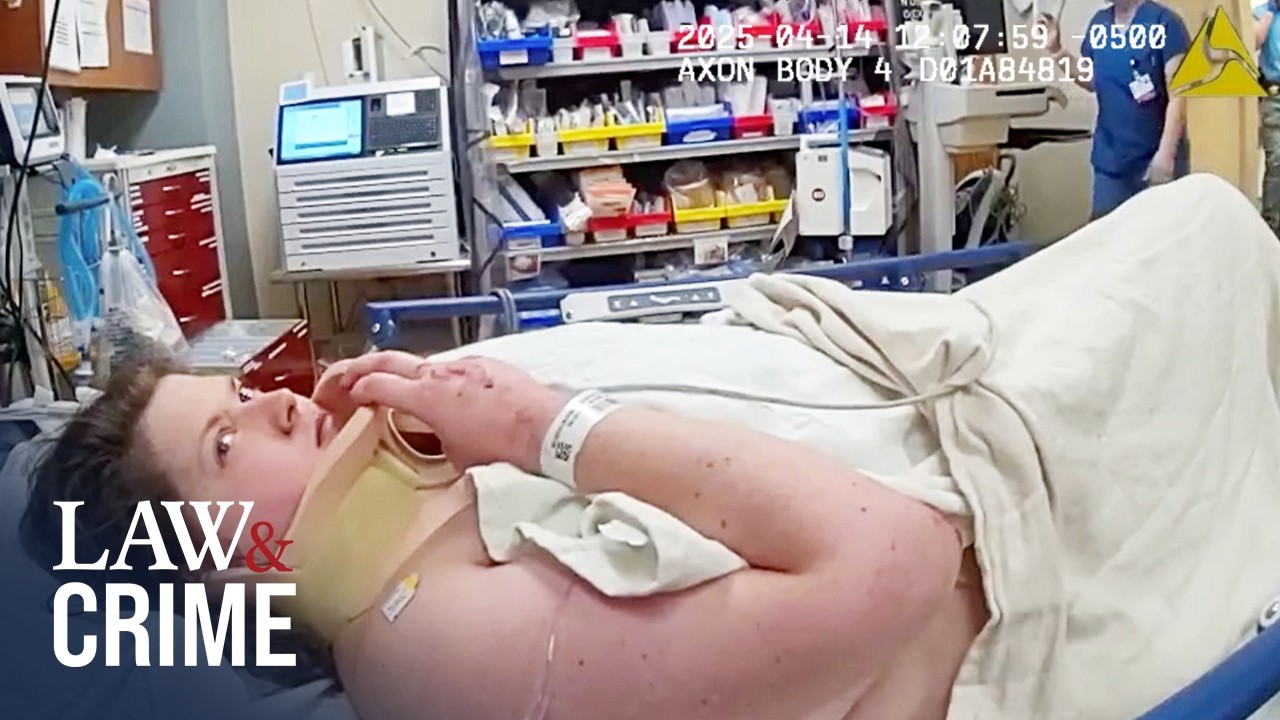
Paramedics transported Sierra Skenover to a local hospital, where she continued to display signs of profound mental disturbance, believing it was 2012 and that she was trapped in a simulation or the Matrix, while also expressing a desperate desire to call her mother.
 In the ambulance, Sierra told paramedics she was 17 years old and spoke about a love from high school who had been “sent away,” weaving together fragmented memories with delusional thinking that left medical personnel struggling to assess her true mental state.
Upon arrival at the hospital, Sierra became increasingly agitated, demanding to call her mother and refusing medical treatment, at one point screaming “CALL MY MOM, HER NAME’S HEATHER” as deputies and medical staff attempted to calm her down.
The situation escalated to the point where Sierra threatened to become physically combative, prompting officers to warn her that she would be restrained to the bed if she could not control her behavior, though she continued to plead for contact with her mother.
Eventually, Sierra began to show signs of lucidity and made a chilling admission to Detective Jason Walters, stating “I think I might have hurt her, I might have gone crazy, like for a bit, and she might be hurt.”
When pressed for details, Sierra confessed directly, saying “I stabbed her, I don’t care if I get arrested because I did not want to do it, I love my mom and I’m so scared and that’s why I want someone to go check on her.”
The detective assured Sierra that an ambulance had been dispatched to her mother’s address, though he did not reveal that Heather Skenover had already been pronounced dead at the scene approximately an hour earlier.
Approximately 40 minutes after her confession, Sierra appeared to slip back into a hallucinatory state, telling medical staff that everyone had “dead eyes” and that their energy was scaring her, demonstrating the rapid fluctuations in her mental status throughout the encounter.
Investigators later learned that Sierra Skenover had a documented history of mental health issues, including depression and a previous incident the day before the murder where she had locked herself in her room, and critically, she had reportedly stopped taking her prescribed medication.
Court records revealed that Sierra had been diagnosed with brief psychotic disorder, a condition characterized by sudden, short episodes of psychotic behavior that typically last less than one month and often resolve with treatment.
Sierra Skenover was formally charged with first-degree intentional homicide in connection with her mother’s death, with her bond set at $1 million, and she was ordered to undergo a comprehensive competency evaluation to determine her fitness to stand trial.
The case took a significant turn when Sierra ultimately entered a plea of guilty, but her defense attorneys argued that she should be found not guilty by reason of insanity, citing her diagnosis of brief psychotic disorder as a temporary condition that rendered her unable to distinguish right from wrong at the time of the killing.
The defense team argued that Sierra should serve only 15 years of institutional care, maintaining that her psychotic episode was an isolated incident triggered by her cessation of medication and that she posed no ongoing threat to public safety.
Prosecutors vigorously opposed this recommendation, arguing that the brutal nature of the crime, combined with Sierra’s erratic behavior and the danger she demonstrated during the attack and subsequent arrest, warranted a lifetime commitment to ensure public safety.
After hearing extensive testimony from psychiatric experts on both sides, the judge ultimately sided with prosecutors and ordered that Sierra Skenover spend the remainder of her life in institutional care, rejecting the defense’s request for a limited sentence.
The Wisconsin Department of Health Services was tasked with determining the specific facility where Sierra Skenover would be placed, though officials have not disclosed her current location due to privacy concerns and security considerations.
Online court records confirm that the placement decision has been made, but the details remain sealed, leaving the public to wonder about the final chapter in this tragic case that transformed a quiet Wisconsin community into the center of a homicide investigation.
The case has raised troubling questions about the adequacy of mental health resources in rural communities, with neighbors and family friends expressing shock that such a violent outburst could occur without more warning signs being recognized by those closest to the family.
Records indicate that Sierra had experienced a mental health crisis the day before the murder, locking herself in her room, and authorities noted she had a history of depression but no known 𝒹𝓇𝓊𝑔 or alcohol involvement, making her sudden violent behavior all the more perplexing to investigators.
The neighbor who witnessed the initial altercation expressed regret that he did not intervene sooner, though he noted that the daughter’s nudity and the chaotic nature of the confrontation made him hesitant to approach, leading him to call authorities immediately instead.
Heather Skenover is remembered by those who knew her as a devoted mother who had been struggling to support her daughter through ongoing mental health challenges, with the family’s private battles now becoming a cautionary tale about the devastating consequences of untreated psychiatric illness.
The case has also sparked discussion among legal experts about the intersection of mental illness and criminal responsibility, with the judge’s decision to impose a lifetime commitment order reflecting a growing trend toward prioritizing public safety in cases involving violent psychotic episodes.
Sierra Skenover’s defense team has indicated they may appeal the sentencing decision, arguing that the lifetime commitment order is excessive given her diagnosis of a temporary psychotic disorder and her lack of prior violent history.
 However, prosecutors maintain that the brutality of the attack, which involved multiple stab wounds to a defenseless mother in her own home, demonstrates a level of violence that cannot be attributed solely to temporary mental illness.
The investigation revealed that Sierra had been experiencing escalating delusions in the days leading up to the murder, including beliefs that she was living in a simulation and that her mother was not real, symptoms consistent with her diagnosed brief psychotic disorder.
Mental health experts testifying at trial noted that brief psychotic disorder can be triggered by extreme stress, trauma, or the sudden cessation of antipsychotic medication, all of which appeared to be factors in Sierra’s case.
The case file contains numerous references to Sierra’s fixation on Arctic Monkeys frontman Alex Turner, with her ambulance ramblings including detailed discussions of the band’s lyrics and her belief that Turner was somehow involved in her delusional worldview.
At the hospital, Sierra’s conversation drifted between topics as disparate as her high school sweetheart, the city of New York, and her love for her mother, demonstrating the fragmented nature of her thought processes during the psychotic episode.
The 911 call and subsequent body camera footage have been preserved as evidence in the case, providing a chilling documentation of the rapid deterioration of a young woman’s mental state and the tragic consequences that followed.
Community members have established a memorial fund in Heather Skenover’s name, with proceeds going toward mental health awareness programs in rural Wisconsin communities where access to psychiatric care remains limited.
The Blue Mountains Sheriff’s Office has declined to comment further on the case, citing the ongoing appeals process and the need to protect the integrity of the investigation.
Sierra Skenover remains in state custody under the Department of Health Services, with her future now determined by the judicial system that found her responsible for her mother’s death while also acknowledging her severe mental illness.
The case serves as a stark reminder of the fragility of the human mind and the devastating ripple effects that can occur when mental health crises go untreated, leaving a family destroyed and a community searching for answers that may never fully come.
As the legal proceedings conclude and Sierra begins her lifetime commitment, the question that lingers is whether this tragedy could have been prevented with earlier intervention and more robust mental health support systems in place.
The memory of Heather Skenover, a mother who died at the hands of her own daughter during a psychotic break, will forever be intertwined with the broader conversation about mental health care in America and the urgent need for reform.
For now, the case is closed, but the wounds remain open in this small Wisconsin town, where neighbors still pass the house on Smoky Mountain Trail and remember the day that shattered their community’s peace forever.