My name is Gerald. I turned seventy-one last October. I spent forty-three years building Harmon Woodworks, a custom furniture company out of Asheville, North Carolina, that I started with nothing but a truck, a set of chisels, and a stubbornness my wife always called my worst quality and my best one at the same time. I never thought I’d end up in a hospital bed wondering if the person sitting next to me wanted me dead.
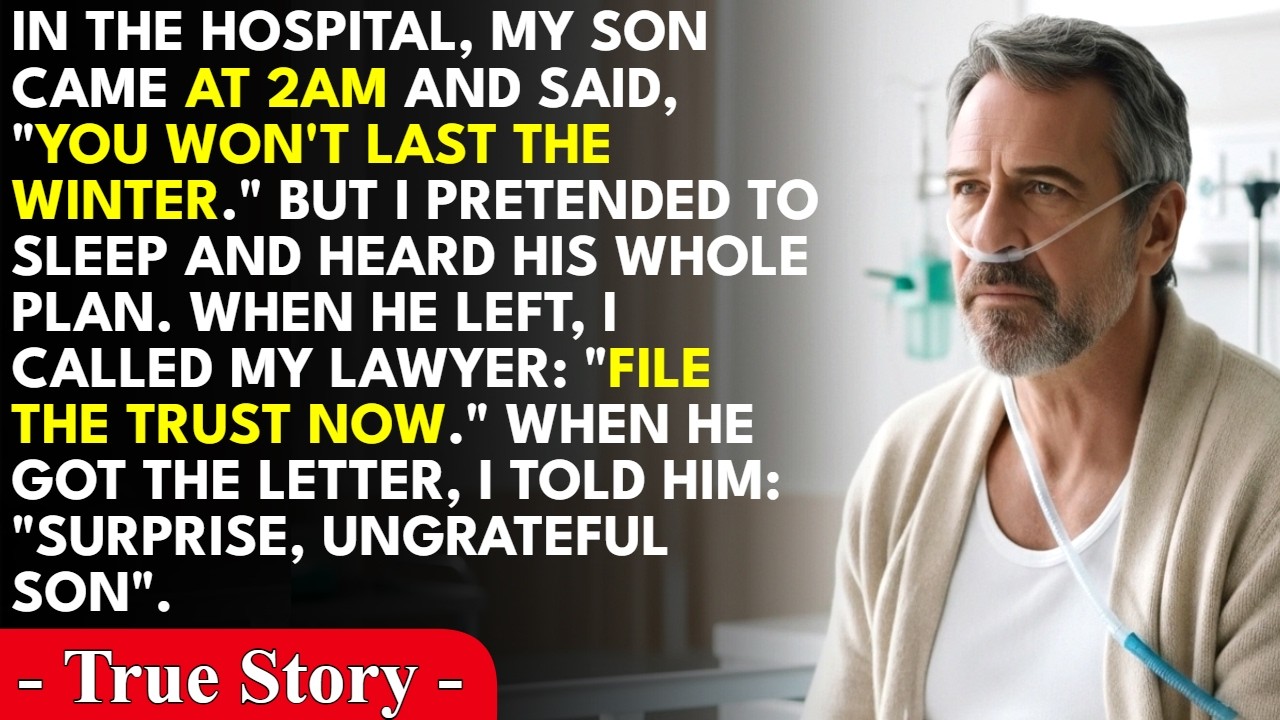
But here I am. And I need to tell you what happened. My wife’s name is Dorothy. We’ve been married forty-five years.
She’s the kind of woman who still leaves a cup of coffee on my workbench in the mornings, even now that I’m retired. She never once asked me for more than I could give, and she never once took more than her share. I want you to understand who she is before I tell you the rest, because everything that happened comes back to the fact that she is the one person in my life who never disappointed me. We have two children.
Our daughter Nora is forty-two. She lives about twenty minutes from us in Black Mountain. She works as a physical therapist and calls her mother every single Sunday without fail. She’s the kind of person who shows up with groceries when you’re sick before you even think to ask.
Then there’s our son, Derek. Derek is forty-five, the older one. And for most of his life, I’ll be honest with you, I gave him more. Not because I loved him more.
I want to be clear about that. But because he asked more, and I didn’t know how to say no. He had a talent for making his problems feel like emergencies. A failed business when he was thirty-two.
Debt from a second one at thirty-six. A house he bought too big for his income. A lifestyle that always seemed to run about twenty percent past what he actually earned. Every few years there was a phone call, a dinner, where he’d get quiet and serious, and then the ask.
And I always said yes, because he was my son. Because I thought that’s what fathers were supposed to do. I don’t know the exact total I gave him over the years. Dorothy knows.
She kept track in a little notebook she never showed me until last year. The number was three hundred forty thousand dollars. Derek never paid back a single dollar. Nora never asked for a single dollar.
I’m telling you this not to make Derek sound like a monster. Not yet. But because you need to understand the shape of things before I get to what happened in February. In January of this past year, I slipped on ice on the back porch.
It was six in the morning, still dark, and I went down hard on my left hip. Dorothy found me twenty minutes later when she came to bring me coffee. I’d been lying on the frozen wood trying not to move, because every time I shifted, the pain went white. They took me to Mission Hospital.
Fractured hip, not fully broken, but serious enough that I needed surgery and then weeks of inpatient rehabilitation. Derek came to the hospital the first evening. He brought flowers, which surprised me because Derek isn’t really a flowers kind of person. He sat in a chair beside my bed, and we talked for a while.
About the surgery, about the recovery, about the ice on the porch that I’d been meaning to salt and never did. He seemed genuinely worried. I remember feeling grateful that he’d come. But then, about forty minutes in, something shifted.
He asked me about the will. Not directly. Derek never does anything directly. He said, “Dad, with everything going on, I just want to make sure I know where things stand, you know, practically speaking.
” He said he’d been thinking about the business. Harmon Woodworks had been dormant for two years since I retired, but there were still real estate and equipment tied to it, and a building on the edge of town I owned outright that had appreciated considerably. He said he just wanted to understand the plan. I told him we could talk about that when I was home.
He nodded and changed the subject. But something sat wrong with me after he left. I couldn’t name it exactly. I’ve known my son for forty-five years, and there’s a particular quality to his voice when he’s calculating something.
It’s very slightly too relaxed, like he’s already decided something and he’s just waiting for the world to catch up. I told myself I was being unfair. I was in pain, I was tired, I was lying in a hospital bed with my hip in a brace. I told myself that.
Nora came the next morning. She didn’t bring flowers. She brought my reading glasses from home, the book I’d been in the middle of, and a container of Dorothy’s chicken soup that she’d quietly driven over to get before coming to the hospital. She sat with me for three hours.
We didn’t talk about the business once. Over the next two weeks, the pattern became clear. Derek visited often. More than I expected, honestly.
And each visit, sooner or later, circled back. Had I talked to James? That’s my attorney, James Whitfield, who I’ve known for over twenty years. Was the building on Crestview Road in my name or in the company name?
What did retirement look like, practically? Did Dorothy have her own accounts? That last question is the one that stopped me cold. I looked at my son sitting in that hospital chair and I said, “Why would you ask that?
” He said he was just trying to get a clear picture. I said I appreciated his concern and that Dorothy and I had things handled. He smiled and said, “Of course you do, Dad. ”
After he left that evening, I lay in the dark for a long time.
And I made a decision. I called Dorothy and told her to bring me a legal pad and a pen the next morning, and to also call James Whitfield and ask if he could come see me at the hospital. I told her not to mention it to Derek. She didn’t ask me why.
She just said, “Okay, Gerald. I’ll call him first thing. ” That’s Dorothy. James came on a Thursday.
We spent two hours going through everything. The will I had written eleven years ago left the business assets and the Crestview building split evenly between Derek and Nora, with the house and remaining savings going to Dorothy outright. It had made sense to me at the time. Equal division, clean and simple.
James listened to what I told him about Derek’s questions and his demeanor. And then he did what good attorneys do. He didn’t tell me what to think. He just asked me what I wanted.
I told him I wanted Dorothy protected first, completely. I told him I wanted Nora to have the Crestview building, because she had been quietly responsible her whole life and had never once asked me for anything. And I thought it was past time I acknowledged that. And I told him I wanted a trust structure, not just a will, something that couldn’t be easily contested, that gave Dorothy lifetime income from everything and passed the core assets to Nora after Dorothy was gone.
I told him I wanted Derek to receive something. I wasn’t going to cut him out entirely. He was still my son. But the majority was going to shift.
James nodded slowly and said, “I think that’s a reasonable and considered decision, Gerald. ” We agreed he would draft the documents and bring them back for signatures. I asked him not to file anything until I told him to. I wanted to wait.
I wasn’t fully sure why at the time. Looking back, I think some part of me was still hoping I was wrong about Derek. I wasn’t. It was a Tuesday, about ten days after I’d met with James.
I’d been moved out of the surgical ward and into the rehab unit on the third floor. Quieter up there, fewer nurses moving through the halls at night. I’d been sleeping badly. Hip pain, unfamiliar sounds, the particular insomnia that comes with being somewhere that isn’t home.
I was awake at around two in the morning, lying with my eyes open in the dark, when I heard the door open. I assumed it was a nurse. They come in at odd hours for vitals, for medication adjustments. I didn’t move.
I kept my eyes mostly closed. It wasn’t a nurse. It was Derek. He came in quietly, the way you move when you’re trying not to wake someone.
He stood at the end of my bed for a moment. I could see him in the dim light from the window, just the outline of him, the shape I’ve known since he was a child. And then he moved to the side of the bed near the equipment. I was on a supplemental oxygen monitor, not full oxygen dependency, just a sensor and a low-flow tube that the doctors had kept on as a precaution given my age and the anesthesia recovery.
A small machine on the rolling cart next to my bed. Derek reached for it. I still didn’t move. I don’t fully know why.
Some combination of shock and instinct, I think. I stayed still. He didn’t remove the tube entirely. What he did was adjust the valve, reduce the flow, and then he stood there watching me.
And then he started talking. Not loudly. Quietly, the way a man talks when he thinks he is alone. He talked about the Crestview building.
He’d found out somehow, through a question he’d asked Dorothy that she’d answered too honestly, not realizing what he was fishing for, that the building had recently been assessed at one point four million dollars. He talked about what that meant for him, for his debts, for his plans. He said he’d waited long enough. He said that I’d never really understood what he was dealing with, that Nora had always been the favorite, even though he was the one who called more and visited more, and that I’d never noticed.
He said, and this is the part that I still hear some nights when I wake up before dawn, “By the time anyone checks on you, old man, you’ll just have drifted off. ” Then he said, “And honestly, at your age, that’s not even a crime. ”
He waited a few more minutes, then he straightened up, looked at me one last time, and left. I waited until I couldn’t hear his footsteps in the corridor anymore.
Then I reached over with one hand and turned the oxygen valve back to where it had been. Then I pressed the call button for the nurse. When she came in, I told her I’d been having trouble breathing and asked her to check my settings. She checked everything, adjusted the monitor, and noted it in my chart.
She didn’t know what had happened. I didn’t tell her yet. I lay there until four in the morning just thinking. At four fifteen, I called James Whitfield.
I know that’s an unreasonable hour to call your attorney. James picked up on the third ring, groggy and confused, and I said, “James, I need you to file those documents tomorrow morning, first thing. ” He was quiet for a second, then he said, “I’ll have them filed by nine, Gerald. ” I said, “Thank you.
” He said, “Do you want to tell me what happened? ” I said, “Not yet. But I need one more thing from you. ”
What I needed from James was a referral, specifically to a private investigator he’d worked with on estate matters before.
A woman named Sylvia, who operated out of Charlotte but worked cases across the western part of the state. I’d never needed anyone like that in my life. I didn’t fully know what I was asking for, but I knew that what Derek had done the night before was not the beginning of something. It was the end of something that had been building for a long time.
And I wanted to understand the full shape of it before I decided what to do next. Sylvia came to the hospital two days later at my request, presenting herself to the staff as a family friend. She sat in the chair by my bed with a notepad, and I told her everything. The questions about the will, the questions about Dorothy’s accounts, the late-night visit, the oxygen valve, what he’d said.
She listened without interrupting. When I finished, she said, “Mr. Harmon, I want to ask you something, and I need you to answer honestly. Is there any possibility you misunderstood what you saw?
” I said, “I was wide awake. I’ve known that man since the moment he was born. I did not misunderstand anything. ” She nodded once.
“Then let’s find out what else there is. ”
There was quite a bit else. Over the following three weeks, while I worked through my rehabilitation and prepared to come home, Sylvia began pulling at threads. What she found was this.
Derek had been in contact with a real estate broker in Asheville for several months. Not to buy property, but to discuss the sale of a specific commercial building on Crestview Road as a potential future listing. He represented himself in those conversations as someone with authority over the property. He didn’t have that authority.
The building was in my name, free and clear. She also found credit card records, obtained through legal process I won’t detail here, showing a pattern of charges that strongly suggested Derek had been drawing on a secondary account linked to an old Harmon Woodworks business account I had stopped actively using after retirement. I hadn’t closed it. I hadn’t thought I needed to.
The amounts were not enormous individually, but over fourteen months they totaled just over forty-seven thousand dollars. When Sylvia showed me these documents in the conference room at James’s office, I sat with them for a long time without speaking. James finally said, “Gerald, this is enough to pursue criminal charges. Fraud, at minimum.
Potentially more, given the incident at the hospital. ” I said, “I know. ” He said, “What do you want to do? ” I told him I wanted to go home first.
I wanted to sit with Dorothy at our kitchen table and tell her everything. And then I would decide. Dorothy already knew something was wrong. She’d known since my first call asking her to contact James, I think.
She’s been married to me for forty-five years. She reads my silences better than most people read plain speech. But she hadn’t pushed. She waited until I was ready.
I came home on a Thursday afternoon. Nora was there to help. She’d taken two days off work to help with my transition home, setting up a temporary bedroom on the ground floor, adjusting the bathroom, stocking the kitchen. She fussed over things quietly and efficiently.
And then, when I settled into the recliner by the front window, she made tea and sat across from me and just said, “Okay, Dad. Whenever you’re ready. ”
I told them everything. Both of them together at that table.
The questions. The late-night visit. What Derek had said in that dark room. The broker.
The missing money. Dorothy was quiet for a very long time. Then she said, “The notebook. ” I said, “What?
” She went to the bedroom and came back with a small spiral notebook. The one she’d kept without showing me. She set it on the table and said, “I’ve been tracking what we gave him. I kept thinking I was wrong, that I was just seeing patterns that weren’t there.
But I kept writing it down anyway. ” She opened it. The entries went back twelve years. Every loan, every amount, every time Derek had come to us with something.
And on the last page, in her careful handwriting, a total: three hundred forty thousand dollars. I looked at that number for a long time. Then I called James from the table and told him to proceed with everything. File the new trust documents.
Report the business account irregularities to the bank and to law enforcement. Forward Sylvia’s findings to the district attorney’s office. And then I asked James one more thing. I asked him to send Derek a certified letter informing him that the estate documents had been revised, that the trust was now in place, and that an attorney would be in contact regarding certain financial discrepancies connected to Harmon Woodworks accounts.
James said, “You want him to know you know. ” I said, “I want him to understand what happened. ”
Derek called me three days after the letter arrived. I didn’t pick up.
He called Dorothy. She picked up, and I sat in the room and listened. He said there’d been a misunderstanding. He said the business account was something he thought I’d authorized.
He said the broker conversation had been exploratory, nothing official. He said he was worried about me, that the hospital stay had affected my thinking, that he thought I should talk to a doctor about what I believed I’d seen that night. Dorothy listened to all of this, and then she said, in a voice I had never quite heard from her in forty-five years, a voice that was very quiet and very clear, “Derek, your father was awake. ” She hung up.
I didn’t say anything. She went to the kitchen and started making dinner, and I sat in my chair by the window and thought about the boy I had driven to his first day of school. The teenager I’d taught to drive in an empty parking lot on a Sunday morning. The young man I had lent money to again and again because I thought I was helping him.
There’s a particular grief that comes with this kind of knowledge. I want to be honest about that. It is not clean. It is not simple, even knowing what Derek did, what he intended to do.
There is still a part of me that mourns the son I thought I had. I don’t think that part ever fully goes away. But grief and justice are not opposites. You can carry one while still pursuing the other.
The district attorney’s office opened a formal investigation six weeks after James filed the report. Sylvia testified as to her findings. The bank confirmed the account irregularities. Derek hired a defense attorney.
His wife, Brenda. I want to be fair to her because I genuinely don’t know how much she knew. She called me once in tears asking me to reconsider. She said Derek had made mistakes but that she and their children would suffer.
I told her I was sorry for that. I meant it. I told her that what Derek had done wasn’t something I had the power to simply absorb on everyone’s behalf, and that the consequences he was facing were the result of his own choices, not mine. She cried harder and hung up.
I sat with that, too. Derek was charged with financial fraud and unauthorized use of business funds. The hospital incident was investigated but ultimately difficult to prosecute. His defense argued it was ambiguous, that there was no direct evidence of intent.
The DA agreed the charge wouldn’t hold. I was disappointed. I won’t pretend otherwise. But the fraud charges moved forward, and ultimately Derek entered a plea agreement.
He would repay what he’d taken with interest over a structured period. He received a suspended sentence and three years of probation. He did not come to the courthouse. His attorney handled everything.
I have not spoken to Derek since Dorothy’s phone call. The trust is now in place. Dorothy is protected fully, clearly, with no ambiguity. The Crestview building belongs to Nora outright.
I made sure the documents explain the reasoning, at James’s suggestion, so there could be no confusion and no successful challenge. Nora cried when I told her. Not dramatically. That’s not who she is.
She just got very still, and then she took my hand, and then she went quiet for a minute, and then she said, “Dad, you didn’t have to do that. ” I said, “I know. That’s exactly why I wanted to. ”
Dorothy and I have talked about what the future looks like.
We’ve talked about selling the house and moving somewhere smaller, maybe closer to Nora. We’ve talked about a trip. Something we put off for years and always meant to take. There’s a stretch of the Oregon coast we both wanted to see since we were young.
We have time now. We have enough. After everything, we have enough. I don’t tell this story to make my son into a villain for strangers to hate.
I tell it because I was a seventy-one-year-old man lying in a hospital bed in the dark, and I made a choice in that moment to be still and to listen and to pay attention. And that choice, as quiet as it was, changed everything. I spent forty-three years building something with my hands. I thought the hardest thing I’d ever do was start a business from nothing.
I was wrong. The hardest thing was learning at the end of my life that the person I needed to protect my family from was someone I had loved since before he could walk. But I also learned something else. The people who show up with your reading glasses and your wife’s chicken soup, those people are worth protecting.
And it is never, ever too late to do right by them. I’ve thought a lot about what I would have done differently. Not in terms of Derek, what he chose. He chose, and those choices had a weight that no amount of second-guessing on my part could have changed.
But I think about myself. The version of me who kept writing checks because it felt easier than having an honest conversation. The version who told himself that giving money was the same as giving love, and that if he just gave enough, the relationship would eventually become what he always hoped it would be. It doesn’t work that way.
I know that now in a way I only half understood before. What we repeatedly do shapes what we become. And what we repeatedly allow shapes what the people around us become, too. Every time I handed Derek money without accountability, I wasn’t just solving his problem.
I was teaching him something. I was teaching him that problems could be solved that way. That consequences weren’t really final. That there was always a next conversation, another check, another extension of grace.
I thought I was being a good father. What I was actually doing was building a man who never learned to stand on his own weight. That’s not blame. That’s just cause and effect.
What saved me, and I mean that in a very literal sense, was something I almost didn’t let myself do. I almost dismissed what I felt when Derek started asking those questions in my hospital room. I told myself I was being unfair. That I was in pain and tired and reading too much into things.
That’s the thing about instinct. It’s usually right, and we spend enormous energy talking ourselves out of it. The one good decision I made in those early days was to stop talking myself out of what I was clearly seeing. Dorothy knew.
She’d been keeping that notebook for twelve years. She never showed it to me because she didn’t want to cause a fight. Didn’t want to be the one who broke something. That quiet, careful courage she carried alone for over a decade.
I think about that a lot. I think about what it cost her to hold that truth and say nothing. And I think about what it means that even then, she never stopped leaving coffee on my workbench in the mornings. Nora never asked for anything, not once in forty-two years.
And I spent decades so focused on Derek’s next crisis that I half forgot to notice her. I think that’s the part that sits with me the longest. Not what Derek did. What I almost failed to do for her.
Not because I didn’t love her, but because I was looking in the wrong direction. Pay attention to the quiet people. They are usually the ones who have earned something. Strength doesn’t always announce itself.
Loyalty doesn’t always ask to be noticed. And it is never too late. I was seventy-one years old, lying in a rehabilitation unit, when I figured this out. It is never too late to correct the record and do right by the people who showed up.
I am still here. And I did not waste the time I had left.