Beatrice’s knife moved with the precision of decades spent feeding people who never noticed the hands that prepared their plates. The blade whispered through a ripe strawberry, releasing a faint, sweet tang into the warm kitchen air. Sunlight slanted through the window above the sink, catching the faint tremor in her wrist before she stilled it. From the living room, the laughter rose again—bright, careless, expensive.
“Honestly, it’s like having a live-in maid.”
Emily’s voice floated in like perfume laced with arsenic. Then the chorus: three other women, wineglasses clinking, joining in as if the joke had been waiting all afternoon to land.
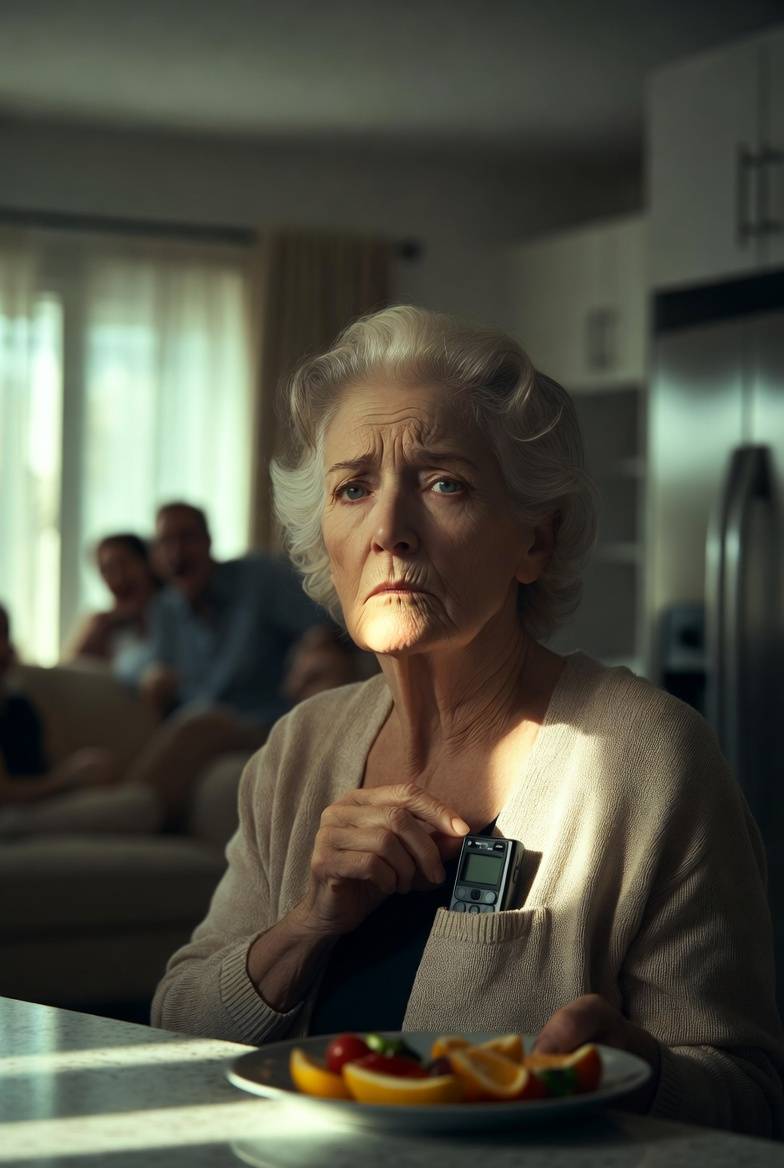
Beatrice did not flinch outwardly. Her face remained the same pleasant mask she had worn for three years—soft gray hair pinned neatly, apron tied with a bow her granddaughter had once insisted on. But inside, something ancient and patient finally snapped its leash. Not with rage. With clarity.
She had heard worse. The muttered comments about her “old-fashioned” cooking. The eye-rolls when she offered to watch the children so Emily could “finally have a life again.” The way her son, Michael—her Michael—would clear his throat and change the subject instead of defending the woman who had mortgaged her own future to give him his.
The recorder in her cardigan pocket felt warm against her ribs. Its red light blinked steadily, a tiny heartbeat of proof.
She finished the tray. Sliced mango arranged like orange petals. Crackers fanned in a perfect arc. A small crystal bowl of almonds because Emily once mentioned they were “brain food” during one of her wellness podcasts. Beatrice carried it into the living room with the same quiet grace she had carried every burden since her husband’s funeral.
The women barely glanced up. Emily, thirty-eight and luminous in linen that cost more than Beatrice’s monthly Social Security check, waved a manicured hand. “Just set it there, Bea. Thanks.”
Beatrice set it down. Her eyes met Michael’s for half a second across the room. He was scrolling on his phone, jaw tight, pretending not to have heard. He looked away first.
That night, after the guests left and the children were in bed, Beatrice sat at the small desk in her converted sunroom—her only real private space in this house that technically still bore her name on the deed. She opened the manila envelope she had kept hidden for fourteen months.
Inside: copies of the original mortgage papers from when she had co-signed to help Michael and Emily buy their dream home after his startup failed. Bank statements showing the thousands she had quietly transferred to cover property taxes when Emily’s “influencer income” dried up. And the most damning document of all—a letter from her late husband’s estate attorney that no one else had ever seen.
The house had never been fully transferred. Beatrice had retained a life estate and a clause that protected her contributions. Michael had always assumed she would simply sign it over one day. They all had.
She pressed play on the recorder. Emily’s voice filled the small room, sharp and mocking.
Beatrice listened without tears. She had cried enough in the first year. Now she took notes in her careful, looping handwriting.
The next morning smelled of coffee and possibility. Beatrice made breakfast as usual—oatmeal with fresh berries for the grandchildren, avocado toast arranged like art for Emily. But when Michael shuffled into the kitchen in his expensive robe, she spoke first.
“I need to talk to you about the house.”
He paused mid-pour, coffee splashing slightly. “Mom, it’s too early for this.”
“It’s been three years too late,” she said calmly. Her voice did not shake. “I’ve been keeping records. All of them.”
Michael laughed—the same uncomfortable chuckle he used when Emily made her little jokes. “What records? You’re not making sense.”
Beatrice slid the recorder across the granite island. She pressed play.
Emily’s voice. The laughter. The casual cruelty.
Michael’s face drained of color. For the first time in years, he truly looked at his mother—not as the background help, but as the woman who had once carried him through childhood illnesses, who had worked double shifts so he could attend college, who had buried her own dreams without complaint.
“Mom… that’s not—”
“It is,” Beatrice said. “And I’m done.”
She did not raise her voice. She did not need to. The silence that followed was louder than any scream.
Emily found out that evening.
She stormed into the sunroom where Beatrice was packing a small suitcase. The children’s drawings still hung on the walls, but Beatrice’s few personal items were already in boxes.
“What the hell is this?” Emily demanded, phone in hand, screen already open to Michael’s frantic texts. “You’re recording us now? Like some paranoid old—”
“Careful,” Beatrice interrupted softly. “The recorder is still running.”
Emily froze. For the first time, the younger woman saw the steel beneath the gentle facade. Beatrice stood straighter than she had in years, the afternoon light catching the silver in her hair like a crown.
“I have every financial contribution documented,” Beatrice continued. “Every late-night cleanup after your parties. Every time I bit my tongue while you treated me like furniture. The house was never fully yours, Emily. And I’m taking back what’s mine.”
“You wouldn’t dare,” Emily hissed. “Michael would never let you throw us out. This is our home.”
Beatrice smiled then—a small, sad, terrifying smile. “Your home? I paid for the roof over your head while you laughed at me. Michael knows it. And deep down, so do you.”
The weeks that followed were a masterclass in quiet devastation.
Michael tried to mediate. He begged. He raged. He even cried one night in the kitchen where it had all begun, confessing how trapped he felt between his wife’s ambitions and his mother’s sacrifices. Beatrice listened without interrupting. Then she handed him tissues and reminded him that being a good son had never required being a silent accomplice.
Emily fought dirty—subtle digs in front of the children, threats of lawyers, even a tearful social media post about “elder manipulation” that backfired when old friends of Beatrice’s began reaching out with their own stories.
But Beatrice had spent three years observing. She knew every weakness. She moved with the calm precision of a woman who had nothing left to lose and everything to reclaim.
She found a small, bright apartment near the ocean. She enrolled in a watercolor class she had dreamed about for decades. She started writing down her own story—not for revenge, but for herself. And slowly, the children began asking to visit “Grandma’s new house” more than they asked to stay in the big one with the cold laughter.
One evening, as the sun dipped into the Pacific and painted the sky in bruised oranges and tender pinks, Beatrice stood on her tiny balcony. The recorder was gone. The manila envelope had been delivered to her attorney.
Her phone buzzed. A message from Michael.
We’re selling. She agreed. I’m sorry, Mom. I should have stopped it years ago.
Beatrice did not reply immediately. She watched the waves roll in, steady and relentless, like the quiet strength she had finally allowed herself to feel.
She typed back one line:
You still can.
The story was far from over. Emily would not go quietly. Michael’s guilt would test every remaining bond. The children would feel the fracture. And Beatrice—quiet, thoughtful Beatrice—would discover that taking back her power was only the beginning of a far more dangerous freedom.
Because once a woman stops serving everyone else’s version of family, she might finally begin to build her own.
The realtor’s sign went up on the lawn three days later, white and arrogant against the manicured grass. Beatrice watched from her car across the street, engine idling, a paper cup of tea cooling in her hand. The Pacific wind tugged at the sign, making the bold red letters—For Sale—flutter like a surrender flag. She did not smile. Victory tasted too much like grief.
Inside the house, Emily moved like a storm in Lululemon. Her voice carried through the open windows, sharp enough to cut glass.
“Michael, tell her she can’t do this! We have equity. We have rights.”
Beatrice could not hear her son’s reply, but she could imagine the slump of his shoulders, the way his fingers would rake through hair that was thinning faster every year. Thirty-nine years old and still caught between two women who both believed they owned him.
She drove away before anyone noticed the silver Toyota. Some ghosts were better left unseen.
Her new apartment smelled of fresh paint and salt air. One bedroom, one bath, a galley kitchen that faced the ocean. Beatrice unpacked slowly, folding her cardigans into drawers with the same care she had once used on other people’s laundry. Each movement felt deliberate, almost sacred. For the first time in years, the hands that worked belonged only to her.
The watercolor class met on Tuesdays at a sun-drenched studio two blocks away. She arrived early, palette in hand, nerves fluttering like the gulls outside. The instructor, a weathered woman named Rosa with laugh lines deep as canyons, took one look at Beatrice’s trembling fingers and smiled.
“First time letting yourself be the student instead of the caretaker?”
Beatrice’s throat tightened. She nodded.
Rosa placed a brush in her palm. “Then paint what hurts, darling. The canvas can take it.”
That evening, Beatrice painted the kitchen tray—sliced fruit bleeding red across thick paper, crackers scattered like broken promises, a shadow of a woman standing just out of frame. She did not cry. The tears had dried up somewhere between the third and fourth year of silent service. Instead, she felt a low, steady burn in her chest. Something waking up.
Michael showed up unannounced on Thursday evening, rain streaking the windows like silver veins. He looked exhausted, designer stubble uneven, eyes ringed with the kind of guilt that no amount of expensive coffee could erase.
“Mom. We need to talk.”
Beatrice let him in. She did not offer tea. Small mercies were no longer her default.
They sat at the tiny dining table. Michael’s knees barely fit. He stared at the watercolor on the wall—the bleeding fruit, the absent shadow.
“That’s… us, isn’t it?”
“It’s what I carried,” Beatrice said quietly. “Every day.”
He rubbed his face. “Emily’s lawyering up. She says you’re unstable. That you’ve been manipulative for years. Recording us like some… spy.”
Beatrice’s laugh was soft, almost tender. “Manipulative. Interesting word from a woman who called me a maid in my own home.”
Michael winced. “I know. I should have—”
“You should have,” she agreed. No anger. Just fact. “But you didn’t. And now the house is selling, and I will receive what is rightfully mine. The rest is up to you.”
He pulled an envelope from his jacket. Legal papers. Demands. Accusations dressed in formal language. Beatrice scanned them without surprise. Emily’s signature was bold, angry loops at the bottom.
“They want you to sign a release. Drop any further claims. In exchange, they’ll… help with your living expenses.”
Beatrice set the papers down. Her hand did not shake. “They want me to disappear again. Quietly. Gratefully.”
Michael’s voice cracked. “I’m caught in the middle, Mom. The kids… they keep asking why Grandma left.”
The words landed like stones in still water. Beatrice felt the ripple move through her—pain, sharp and familiar, followed by something harder. Resolve.
“Tell them the truth,” she said. “Or I will.”
That night, Emily called.
Beatrice almost didn’t answer. But the phone kept ringing, insistent, like the woman herself.
“Beatrice.” Emily’s voice was honey over broken glass. “This has gone too far. We’re family.”
“Family,” Beatrice repeated. She stood on the balcony, wind whipping her hair. Below, waves crashed against the rocks, steady and unforgiving. “You laughed while I served you, Emily. You taught my grandchildren that their grandmother was furniture. That is not family. That is ownership.”
A pause. Then the mask slipped.
“You think you’re so noble? You chose to stay. You liked being needed. Admit it.”
Beatrice closed her eyes. The truth in those words stung, but only for a moment. “I chose love. You chose convenience. There’s a difference.”
Emily’s breathing quickened. “Michael will never forgive you for this. The kids will resent you. And when this house sells, you’ll still be alone. Just an old woman with a recorder and a grudge.”
The line went dead.
Beatrice lowered the phone. Her reflection in the dark glass showed a woman who no longer looked away. The burn in her chest flared brighter.
She opened her laptop and began typing. Not a legal response. Not yet. She wrote the first page of her own story—the one she had lived in silence. The one no one had ever asked to hear.
Two days later, the first crack appeared in Emily’s armor.
Michael called again, voice hushed and urgent. “She’s been drinking more. The kids heard her on the phone… saying things about you. About how you ‘trapped’ us with money. Sophie asked me if Grandma was a witch.”
Beatrice’s heart squeezed. Little Sophie, six years old, with her gap-toothed smile and the way she used to crawl into Beatrice’s lap after nightmares.
“Bring them to me this weekend,” Beatrice said. “No lawyers. No Emily. Just the children.”
Michael hesitated. “She’ll fight me on it.”
“Then choose, Michael.” Her voice was steel wrapped in silk. “Choose who you want to be.”
The call ended. Beatrice stared at the ocean until the sun bled out. She did not know if he would come. But for the first time, she realized it no longer defined her worth if he didn’t.
Late that same night, her phone lit up with an unknown number. A message.
You think you’re winning? I have recordings too. Every complaint you ever made about me. Every time you criticized my parenting. Check your email.
Attached was a video file. Emily, sitting in the same living room, tears streaming artfully down her face, speaking directly to the camera.
“Beatrice has always been jealous. She never wanted me to have a life. She wants to control everything…”
Beatrice watched the entire thing without pausing. When it ended, she saved it. Then she opened the manila envelope again and added the new evidence to the growing file.
The game had changed.
Emily was no longer just cruel.
She was desperate.
And desperate people made mistakes.
Beatrice stepped back onto the balcony. The waves roared below, louder now, as if the ocean itself sensed the coming storm. Somewhere in the darkness, her granddaughter might be crying for a grandmother who had simply stopped enduring.
She whispered into the salt wind, voice steady:
“Come and get me, then.”
Saturday arrived wrapped in marine layer, the kind of gray that softened edges and hid sharp truths. Beatrice spent the morning arranging the small apartment like a stage—fresh strawberries on a plate (no tray this time), crayons scattered across the coffee table, and a blanket fort in the corner because Sophie had once declared it “the best hiding place in the whole world.” Her hands moved with quiet hope. For the children, she would still serve. But now, on her terms.
Michael arrived at ten sharp, holding each child’s hand like they might vanish. Sophie, six, clutched a stuffed rabbit missing one ear. Lucas, four, dragged a toy truck, wheels squeaking against the tile. Their eyes were wide, uncertain—the same look Beatrice had worn for years in that other house.
“Grandma!” Sophie broke free first, barreling into Beatrice’s arms with the force of a small hurricane. The scent of strawberry shampoo and childhood filled Beatrice’s chest until it ached.
Lucas hung back half a second, then followed, burying his face in her sweater. “Mommy said you were mad at us.”
The words landed like a slap. Beatrice met Michael’s eyes over their heads. He looked hollowed out, a man watching his life split down the middle.
“I’m not mad at you, my loves,” Beatrice whispered, kneeling so she was eye-level with them. “Never at you. Sometimes grown-ups have big problems, and the children get caught in the middle. But this is our time. No problems today.”
They believed her. Children always did, until the world taught them otherwise.
The afternoon unfolded in watercolor hues. They built the fort. They painted—Sophie creating a bright yellow sun over a house that looked suspiciously like the old one, Lucas smearing blue trucks across the page. Beatrice cooked simple grilled cheese, cut into hearts because Sophie demanded it. No fanfare. No performance. Just love, unrecorded and unremarked.
Michael hovered in the kitchen doorway, watching. “You make it look easy,” he said quietly.
“It wasn’t,” Beatrice replied, flipping a sandwich. Butter sizzled. “But I chose it. Every day. Until I couldn’t.”
He swallowed hard. “Emily didn’t come. She… she said it would be too upsetting for the kids.”
“Or too upsetting for her,” Beatrice said. She did not press. The silence between them stretched, filled only by the children’s laughter from the other room.
Later, while the kids napped in the fort—tiny bodies tangled under blankets—Michael finally spoke the words that had been poisoning him.
“She has something on me, Mom. From before. The startup. Some… creative accounting. If this goes public, I lose everything. The kids lose their father’s name.”
Beatrice’s brush paused mid-stroke on a new painting. A stormy sea. Dark waves. A small figure standing on the shore. “And you think protecting that secret is worth letting her destroy me?”
He didn’t answer. The shame on his face was answer enough.
The twist came at dusk, when the marine layer had burned off and the sky bled gold and rose.
Beatrice’s phone buzzed on the counter. An unknown number again. She stepped onto the balcony, closing the sliding door so the children wouldn’t hear.
“Beatrice.” Emily’s voice was calm now. Too calm. “I see Michael took the kids to you. Cute. Playing house in your little apartment.”
Beatrice said nothing. She watched the waves.
“I have the original loan documents,” Emily continued. “The ones where you co-signed. But I also have something else. A letter. From your husband, before he died. He wanted the house to go to Michael. Fully. No strings. He just never got around to changing the paperwork. I found it in the storage unit you forgot to clear out.”
Beatrice’s grip tightened on the railing. The wind whipped colder.
“You’re lying.”
“Am I?” Emily’s laugh was soft, almost pitying. “Come to the house tomorrow. Alone. We’ll settle this like adults. Sign the release. Or I’ll make sure Michael’s little financial indiscretions become very public. And I’ll tell the children their grandmother tried to steal their home.”
The line went dead.
Beatrice stood motionless as the sun disappeared. The painting inside—her stormy sea—felt suddenly prophetic. She had thought she held all the cards. But Emily had been digging too. Quietly. Ruthlessly.
Michael stepped out behind her, voice low. “Who was that?”
Beatrice turned. For the first time, she let him see the full weight of her exhaustion. “Your wife just declared war.”
That night, after Michael left with the children—promises of next weekend hanging fragile in the air—Beatrice sat at her desk. The manila envelope lay open. She added Emily’s threat to her growing record, voice steady as she spoke into the new recorder.
Then she opened her laptop and typed the next page of her story. Not for lawyers. For herself.
They thought I was the shadow. But shadows remember every light that cast them.
Sleep came hard. When it did, she dreamed of her late husband standing in the old kitchen, whispering, “I tried to protect you both.” His face blurred. The house around him cracked like thin ice.
She woke before dawn, heart pounding. The apartment was silent except for the distant crash of waves.
Her phone held a new message from an unrecognized number. No words. Just a photo.
The storage unit. Boxes torn open. And in the center, a yellowed letter in her husband’s unmistakable handwriting.
The image was timestamped yesterday.
Emily had been one step ahead.
Beatrice stared at the photo until the screen went dark. The burn in her chest no longer felt like hope. It felt like wildfire.
She whispered to the empty room, voice raw:
“Then we burn together.”
The old house looked smaller in the harsh morning light. The For Sale sign leaned slightly, as if tired of its own lie. Beatrice parked at the curb and sat for a long moment, hands folded in her lap. The Pacific breeze carried the scent of eucalyptus and distant salt, but inside the car it smelled only of the lavender sachet she had tucked into her purse—an old habit from days when she needed courage to walk through her own front door.
She carried no recorder this time. Only a single folder and the weight of decades.
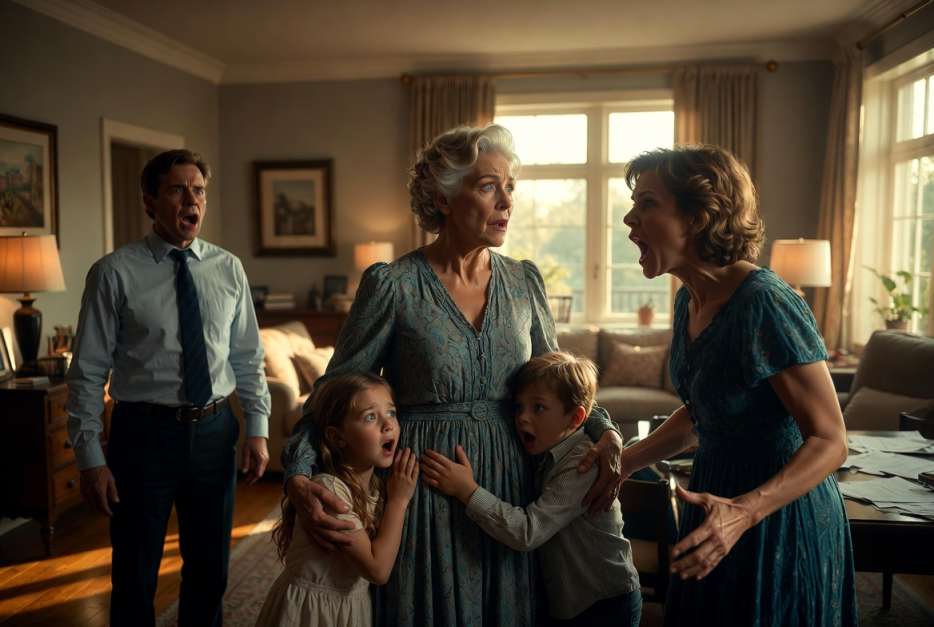
Emily opened the door before Beatrice could knock. She looked flawless—highlighted hair swept into a casual knot, silk blouse the color of expensive cream. But her eyes were sharp as shattered glass.
“You came,” Emily said, stepping aside with exaggerated politeness. “How noble.”
The house felt wrong. Echoes lingered in the empty hallways where children’s laughter used to live. Furniture sat at odd angles, half-packed boxes lining the walls like gravestones. Beatrice’s footsteps sounded too loud on the hardwood she had polished a thousand times.
Michael was not there. Emily had made sure of that.
They sat in the living room where the laughter had once cut deepest. No snacks. No tray. Just two women and the space between them filled with three years of swallowed poison.
Emily slid the letter across the coffee table first. Yellowed paper. Her husband’s handwriting—slanted, certain, the same hand that had once signed birthday cards with silly drawings.
My dearest Beatrice,
If you’re reading this, I’ve left you with a mess. Michael needs the house. Fully. No half-measures. You’ve given enough. Let him stand on his own. I love you both.
Beatrice read it twice. The paper trembled, but her voice did not.
“He wrote this when he was dying,” she said softly. “Morphine and fear. Not clarity.”
Emily leaned back, crossing her legs. “A judge won’t care about context. It proves intent. You kept the life estate out of spite. You wanted control.”
Beatrice met her gaze. “I kept it because I paid for it. Because I saw what your ‘ambition’ did to my son’s future. And because even on his worst day, my husband trusted me to protect this family.”
A flicker—something almost like doubt—crossed Emily’s face. Then it hardened.
“Sign the release, Beatrice. Walk away with enough to live comfortably. The kids need stability. Michael needs his wife. You’ve made your point.”
Beatrice opened her folder. Inside were copies. Bank transfers. Tax records. A doctor’s note from three years ago when she had collapsed from exhaustion cleaning this very house while Emily vacationed in Cabo. And the most recent addition: a statement from the storage facility manager confirming the date Emily had accessed the unit.
“You broke in,” Beatrice said. Not accusation. Statement. “You forged access. That letter was never meant for you.”
Emily’s laugh was brittle. “Proof? It’s your word against mine. An old woman’s paranoia.”
The air thickened. Outside, gulls cried. Inside, the house itself seemed to hold its breath—the walls that had witnessed every silent humiliation now bearing witness again.
Beatrice stood. She walked to the kitchen, the same kitchen where it had all begun. Her hand hovered over the counter where the snack tray had once rested. She could still hear the laughter.
“I didn’t come to argue,” she said, turning back. “I came to offer you a choice.”
Emily’s eyebrows rose, amused.
“Take the equity you’re owed from the sale. Move on with Michael and the children. Build something honest. Or I will take this to court, release every recording, every financial trail, and let the world see exactly what kind of mother you’ve been. Not just to me. To them.”
For the first time, real fear flashed in Emily’s eyes. Not for the house. For the image. The brand. The carefully curated life.
“You wouldn’t destroy your own family,” Emily whispered.
Beatrice’s voice was quiet, almost gentle. “You destroyed it the day you taught my grandchildren that their grandmother was less than human. I’m only refusing to let the ruins stay buried.”
Silence stretched. Then Emily reached for her phone with shaking fingers.
That was when the front door opened.
Michael stepped in, pale and disheveled, carrying a small box. Behind him, Sophie and Lucas peeked out, eyes wide with confusion. They were not supposed to be here.
“Emily,” Michael said, voice rough. “This ends now. I found something in the storage unit too.”
He set the box on the table. Inside: old journals. Beatrice’s journals. Pages filled with quiet entries from the early years—prayers for her son’s happiness, notes about saving for the grandchildren’s college, never a word of complaint. And at the bottom, a second letter. Her husband’s real final letter, dated two weeks before his death.
Beatrice, my rock. The house is yours to decide. Michael must earn it. Protect them from my mistakes. I was wrong to doubt you.
Emily stared at the paper as if it had grown teeth.
Michael looked at his mother, eyes wet. “I should have read these years ago.”
Sophie tugged at Beatrice’s sweater. “Grandma, why is Mommy crying?”
The question hung in the air like smoke. Lucas clutched his toy truck tighter.
Beatrice knelt, gathering both children close. Their small hearts beat against her like fragile wings. Over their heads, she met Emily’s gaze—one final, unbroken look.
The house remembered everything.
And now, so did they.
But as Beatrice held her grandchildren, a new dread coiled in her stomach. Emily’s tears looked real. Too real. And the way her hand moved toward her phone—slow, deliberate—suggested the war was not ending.
It was simply changing weapons.
The children’s questions lingered in the air like smoke after a fire. Sophie’s small fingers twisted in Beatrice’s sweater while Lucas pressed his truck against his chest as if it could shield him from the storm brewing between the adults. The old house, once a monument to fragile dreams, now felt like a courtroom where every wall whispered judgment.
Emily’s tears dried quickly. Too quickly. She wiped her cheeks with the back of her hand, the diamond on her finger catching the light like a warning.
“Michael,” she said, voice trembling just enough to sound wounded, “you brought them here? After I asked you not to?”
Michael stood frozen between two worlds. The box of journals sat open on the table like an exposed vein. His eyes darted from his mother to his wife, the man who had spent years avoiding hard choices now forced to breathe them in.
“I had to,” he whispered. “They deserve the truth.”
Beatrice remained on her knees, arms wrapped around her grandchildren. Their warmth anchored her, but she felt the fracture widening beneath them all. Sophie looked up, eyes wide and shining. “Are you and Mommy fighting because of the house? I like Grandma’s new house better. It has the ocean.”
The innocent words sliced deeper than any of Emily’s barbs. Lucas nodded solemnly. “Grandma makes heart sandwiches.”
Emily’s face twisted. For a fleeting second, something raw and human flickered there—regret, perhaps, or the terror of watching her carefully constructed life collapse. Then the mask snapped back into place.
“You’ve poisoned them against me,” she hissed at Beatrice. “Just like you tried to poison Michael.”
She reached for her phone again. This time, Beatrice saw the screen light up with a name she recognized: Victor Lang, Attorney.
The betrayal came not with shouting, but with the soft click of a sent message.
Michael’s phone buzzed almost immediately. He glanced down, and his face drained of color. “Emily… what did you do?”
Emily stood, smoothing her silk blouse. “I protected our family. Victor’s filing an emergency motion this afternoon. Emotional manipulation. Financial elder abuse. The recordings Beatrice made? They’ll paint her as unstable. Obsessed. And those journals?” She laughed, brittle and sharp. “Selective memory. She wrote plenty about resenting us in the early days. I made sure Victor has copies.”
Beatrice rose slowly, keeping the children behind her. The Pacific light streaming through the windows felt colder now, casting long shadows across the floor she had scrubbed on her hands and knees. “You accessed my private journals?”
“Storage unit, remember?” Emily’s smile was thin. “Everything here was community property once. Or have you forgotten?”
Michael stepped forward, voice cracking. “This is going too far. The kids—”
“The kids need stability,” Emily cut in. “Not a grandmother who records family dinners like some paranoid spy. Sign the papers, Beatrice. Walk away. Or I swear I’ll make sure you never see Sophie and Lucas again.”
Sophie whimpered, burying her face in Beatrice’s side. Lucas dropped his truck; it rolled across the floor and stopped against Beatrice’s shoe like a tiny surrender.
The room spun with the weight of small hands clutching her. Beatrice felt every year of sacrifice surge upward—not as rage, but as a deep, tidal resolve. She had carried this family on her back. She would not let it crush her now.
She looked at Michael. Really looked. The boy she had raised, now a man hollowed by fear. “You still have a choice, son. Right here. Right now.”
Michael’s jaw worked. Tears welled in his eyes. For one heartbreaking moment, Beatrice saw the child he had been, clinging to her after his father’s death. Then he turned to Emily.
“I can’t do this anymore,” he said quietly. “Not like this.”
Emily’s eyes widened. “Michael—”
“No.” He reached for the children, gently prying Sophie’s grip from Beatrice’s sweater. “We’re leaving. All of us. The sale of the house goes through fairly. Mom gets what she’s owed. And we get counseling. Real counseling. Or I’m done.”
The silence that followed was deafening. Emily stared at him as if he had grown another head. Then she laughed—short, disbelieving. “You’ll regret this. Both of you.”
She grabbed her purse and stormed toward the door, heels clicking like gunshots on the hardwood. At the threshold, she paused and looked back at Beatrice. The mask was gone. Only venom remained.
“You think you’ve won? I still have the letter. I still have the recordings of your complaints. This isn’t over.”
The door slammed. The house exhaled.
Michael sank onto the couch, head in his hands. Sophie and Lucas climbed into Beatrice’s lap as if she could hold the world together. She stroked their hair, humming the old lullaby she had sung when they were infants, her voice steady even as her heart raced.
But as the children calmed, a new dread settled in Beatrice’s bones. Emily’s parting look had not been defeat. It had been a promise.
Later that evening, back in her ocean-facing apartment, Beatrice received the call from her own attorney. The emergency motion had been filed. But worse—Emily had leaked a heavily edited version of one of the recordings to a local “mom influencer” group. The caption read: When family turns toxic: my mother-in-law’s secret recordings exposed.
The wildfire was spreading.
Beatrice stood on her balcony as night fell, the waves roaring below like an audience hungry for the next act. Sophie’s stuffed rabbit lay forgotten on the table inside—a small, earless sentinel.
She whispered to the darkness, the wind carrying her words out to sea:
“I protected you for years. Now I protect what’s left of me.”
But deep down, she knew the most dangerous storm was still gathering. Because desperate people did not simply lose.
They destroyed.
The weeks that followed blurred into a relentless current of filings, whispers, and late-night calls. The leaked recording spread like oil on water—twisted snippets that painted Beatrice as the bitter intruder rather than the silent backbone. Comments flooded in: toxic MIL, poor Emily, protect the kids. Beatrice read them once, then closed the laptop and walked to the ocean. The waves did not care for public opinion. They simply kept moving.
Her attorney, a sharp-eyed woman named Carla who reminded Beatrice of Rosa from watercolor class, fought like a lion. “We have the originals,” Carla said in their final strategy meeting. “Timestamps. Financial trails. And your husband’s true letter. This ends in mediation, not court.”
Beatrice nodded. She had already decided. No more public spectacles. The children had seen enough broken pieces.
The mediation room smelled of stale coffee and nervous sweat. Neutral beige walls, a long table, and two mediators who looked like they had heard every variation of family destruction. Emily arrived in armor—tailored blazer, perfect makeup, Victor Lang at her side like a hired sword. Michael sat apart, shoulders straight for the first time in years.
Beatrice entered last, carrying only a small leather portfolio and the quiet dignity that had carried her through decades of unseen labor. She wore the soft gray cardigan from that fateful afternoon in the kitchen. The hidden pocket was empty now. No recorder. Only truth.
Emily refused to meet her eyes at first. When she did, the desperation was naked.
The mediators laid out the terms. The house sale proceeds would be divided according to documented contributions—Beatrice’s name still carried legal weight. Custody and visitation for the grandchildren would remain open, with mandatory family counseling. Michael’s financial indiscretions from the startup years would stay buried if all parties signed a comprehensive NDA and release.
Emily’s hand shook as she held the pen. “This will ruin me online.”
“You ruined yourself,” Beatrice said softly, not with triumph, but with the sorrow of someone who had watched a house burn from the inside. “Every laugh in that kitchen. Every time you let the children see you diminish me. That was the ruin.”
Michael spoke then, voice steady. “I’m moving out, Emily. The kids need both of us, but not like this. I’ve already found an apartment near Mom’s. We’ll co-parent. Fairly.”
Emily looked at him as if he were a stranger. For a long moment, the room held only the sound of the air conditioning and distant traffic. Then she signed. One sharp stroke. No tears this time. Only the hollow click of the pen.
When it was Beatrice’s turn, she paused. She looked at each of them—her son, carrying the weight of his failures; Emily, a woman who had mistaken control for strength; and the empty chairs where her grandchildren should have been.
She signed.
Not for victory. For release.

That evening, the ocean sang louder. Beatrice stood on her balcony with Sophie on one side and Lucas on the other, wrapped in a shared blanket as the sun bled gold across the water. Michael cooked inside—simple pasta, nothing fancy. He burned the garlic slightly. No one complained.
Sophie tugged Beatrice’s sleeve. “Grandma, are you still mad at Mommy?”
Beatrice knelt, brushing a curl from the little girl’s forehead. “I was hurt, sweetheart. Deeply. But I’m choosing peace now. For all of us. Your mommy and I may never be friends, but we both love you.”
Lucas drove his truck along the railing, making engine noises. “Heart sandwiches tomorrow?”
Beatrice smiled—the first real, unburdened smile in years. “Every day if you want.”
Later, after the children were tucked into the makeshift beds in her small living room, Michael joined her on the balcony. The stars were sharp overhead, the kind that only appeared after storms.
“I was a coward,” he said. “For years.”
“You were human,” Beatrice replied. “But you chose better when it mattered most.”
He hesitated, then handed her an envelope. Inside: a check for more than she had claimed in mediation. And a note in his handwriting.
For every meal you made. Every bill you covered. Every time I didn’t say thank you. I love you, Mom.
Beatrice folded it carefully. No words were needed. The tide had done its work.
Months later, the old house sold to a young family full of hope. Beatrice did not drive by to watch the new owners move in. She was too busy living.
Her watercolor paintings now hung in a small local gallery—stormy seas giving way to calmer shores. She taught a weekly class for other women rediscovering their own hands. Rosa became a friend. The ocean became home.
Emily kept her distance, though occasional polite texts arrived about the children. The influencer posts grew quieter, the brand shifting toward “healing and boundaries.” Some masks simply changed shape.
Michael struggled, but he showed up—for counseling, for weekends, for the slow rebuilding of trust. The children thrived between two homes, carrying pieces of both worlds.
One evening, as Beatrice stood on the balcony watching the sunset paint the sky in the same bruised oranges and tender pinks as that first day of freedom, her phone buzzed with a new message from Sophie.
Grandma, I painted you a picture. It’s the ocean and you standing big and strong. Love you forever.
Beatrice closed her eyes, letting the salt wind brush her face. The woman who had once frozen in that kitchen, hand hovering over a snack tray while laughter cut like knives, was gone.
In her place stood someone new.
Not a maid. Not a shadow.
A woman who had learned, finally, that the most powerful thing a person could do was stop serving poison and start feeding her own soul.
The recorder was long gone. The manila envelope sealed.
And the laughter that echoed in her memory now was her grandchildren’s—bright, unguarded, and entirely hers to cherish.
The tide had receded, leaving the shore clean for whatever came next.