East Tennessee’s only woman on death row is about to get a rare hearing to challenge her own execution. This is the story of Christa Pike, and it is one of the strangest death penalty fights in the country.
Christa Pike is scheduled to be executed in 17 days. And she has said no to every single way the state of Tennessee can do it.
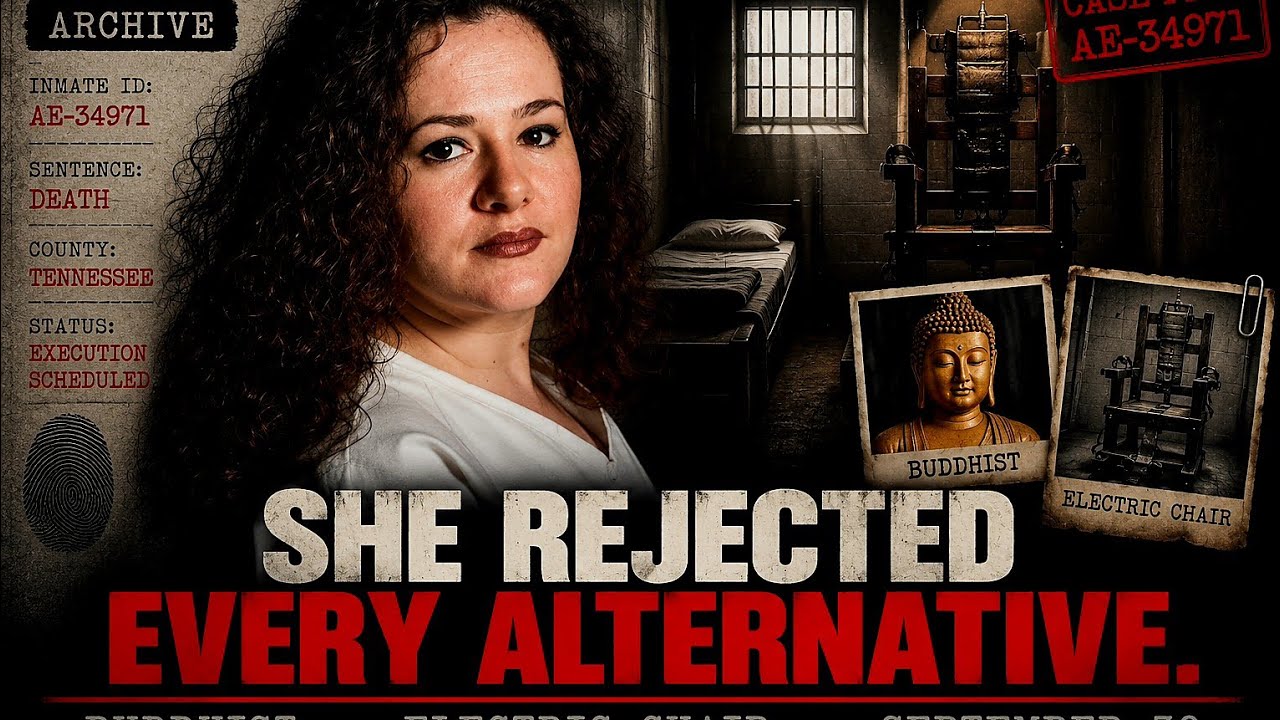 They offered her lethal injection. She said it would torture her body.
So, the state said, “Fine, you can have the electric chair instead.”
And she said no to that one, too.
Here is the part that sounds impossible. She is not refusing to die because she is afraid. She has never claimed she is innocent.
She is not asking to walk free. She is refusing to choose.
And the reason why is going to take this entire story to explain, because it isn’t really about the needle or the chair at all. It’s about a rule almost no one knows exists, and a belief that runs straight into it.
By the end, you are going to have to decide something uncomfortable. Whether this is the most trapped person in America right now, or the most clever.
Let’s start with who she is. Quickly. Because the crime is not the point here, but you need it to understand the stakes.
In 1995, Christa Pike was 18 years old, a student at a job training program in Knoxville, Tennessee. That year, she and two others lured a 19-year-old classmate named Colleen Slemmer into the woods and tortured her to death. It was one of the most brutal murders the state had ever prosecuted.
Pike confessed. She was sentenced to death in 1996. And she has been the only woman on Tennessee’s death row ever since, for 30 years.
None of that is in dispute. She did it. This story is not going to tell you otherwise, and it is not going to ask you to feel sorry for her.
Colleen Slemmer never got to choose anything about how her life ended, and you should hold on to that for everything that follows.
But three decades later, in the final months before her execution, Christa Pike did something that turned her case into one of the strangest death penalty fights in the country. She looked at every method the state of Tennessee had to 𝓀𝒾𝓁𝓁 her, and she said no to all of them. Not because she wanted a different one, because, as you’re about to see, she said she could not choose any of them at all.
And the fight over whether that was sincere faith or a brilliant piece of strategy went all the way to the Tennessee Supreme Court.
To understand why, you have to take her refusals one at a time.
Start with the needle.
Tennessee’s default way of killing someone is lethal injection. And not long ago, the state changed how it does it, switching to a single 𝒹𝓇𝓊𝑔, a powerful barbiturate called pentobarbital, meant to shut down the body’s breathing and stop the heart.
There is a reason the state changed its method, which matters here. Not long before, an independent review found Tennessee had not been properly testing its execution drugs the way its own rules required. A failure serious enough that the governor paused every execution in the state over it.
So, the protocol Christa Pike is objecting to is itself the product of a system that had already been caught cutting corners with the chemicals it uses to 𝓀𝒾𝓁𝓁 people. That is the backdrop her lawyers are standing in front of when they say, “You cannot be trusted to do this cleanly on her.”
When Pike’s lawyers looked at that protocol, they said it would not work the way it is supposed to on her. And that on her specific body, it would be torture.
Here is their argument. Christa Pike has a blood disorder. She has small, damaged veins that make it hard to get an intravenous line into her, the line they need to deliver the 𝒹𝓇𝓊𝑔.
And her lawyers argued that because of her condition, the 𝒹𝓇𝓊𝑔 would not move through her the way it is designed to.
In their filings, they described the risk in language that is hard to forget. That it could fill her lungs with what they called a bloody froth.
Picture the difference. The state promises her she will simply drift off to sleep and not wake up. Her lawyers are describing something closer to drowning.
Awake and unable to breathe while the people in the room believe it is going fine.
That is the gap they say her body creates.
Now, your first instinct might be that this is exactly what you’d expect a death row inmate to say. Of course, she says it’ll hurt. Of course, she’s looking for a problem.
And the state said more or less exactly that. That this was speculation. That lethal injection is a settled constitutional method.
And that she hadn’t proven she faced any special risk.
Except here is the thing that makes her fear impossible to wave away.
A few months before all of this, in May of 2026, the state of Tennessee tried to execute another prisoner, a man named Tony Carruthers. And it went wrong.
The execution team could not get the intravenous line in. They tried and tried for more than an hour, and they could not do it. Eventually, the state had to call the whole thing off.
So, when Christa Pike’s lawyers say the state might not be able to do this cleanly on a woman with damaged veins, that is not a hypothetical. It already happened on someone else weeks earlier. Badly enough that more than 40 medical professionals wrote to the governor asking him to stop.
That is refusal number one, and it is the easy one to understand. She is afraid of a botched execution, and the state gave her a concrete reason to be.
So, Tennessee offered her the oldest alternative it still owns. The electric chair.
And this is where the story stops making ordinary sense.
 There is something about Christa Pike’s case that most people don’t know, because her crime happened so long ago. Back in 1995, she has a legal option that most people sentenced to death today do not.
Under Tennessee law, she is allowed to choose the electric chair instead of lethal injection.
And that alone is unusual. Most of the country has walked away from the electric chair entirely. It belongs to an older era of American executions, the one of visible burns and witnesses looking away.
And for decades, the trend has been to retire it as too violent, too likely to go horrifically wrong.
Only a small handful of states still keep it available at all. And even in those, it is usually treated as a relic rather than a real choice.
But Tennessee is one of them. And for a prisoner whose case reaches back to the 1990s, that old law still applies. The chair is genuinely on the table for her.
So, the state’s position became simple. You don’t want the needle? Fine.
You have another choice right there available to you. Take the chair.
And Christa Pike said no to that, too.
Sit with how that sounds for a second. We are going to complicate it later, but right now it should land exactly the way the state wants it to land.
Here’s a woman who says lethal injection will torture her. She is handed a completely different method, one that does not involve a needle or her veins or her blood at all, and she turns it down.
At this point, you can see the state’s whole case forming, and honestly, you can probably feel it yourself. It looks like someone who is not actually objecting to a method. It looks like someone who is objecting to being executed at all, and who will find a reason to say no to anything you put in front of her.
Refuse the needle, refuse the chair, and you can’t be executed because there’s nothing left.
Her reason for refusing the chair was her religion.
Christa Pike is a Buddhist. And she said her faith would not let her choose it.
And if your reaction to that is a raised eyebrow, a convenient faith discovered at a convenient time blocking the one method that was left, then you are having exactly the reaction the state was counting on. That is precisely how the prosecution wanted it to look.
But there is a rule sitting underneath this entire case, a rule almost nobody outside of death penalty law has ever heard of. And once you understand it, her refusals stop looking like a woman dodging every option and start looking like a woman walking straight into a wall.
Everything up to here is the surface of this case. What’s underneath it is the part almost nobody talks about. And it’s what turns this from a strange headline into something much harder.
Here is the rule.
In the United States, if you are on death row and you want to challenge the method the state plans to use to 𝓀𝒾𝓁𝓁 you, if you want to go into court and say this specific method would be cruel, it is not enough to say no.
Under a decision from the United States Supreme Court, you are legally required to do something else. You have to point to a different method, one that is actually available, and argue that it would hurt less. You have to hand the court an alternative.
This comes from a Supreme Court case called Bucklew versus Precythe, decided in 2019, building on an earlier ruling a few years before it.
The court’s reasoning went like this. The Constitution bans cruel and unusual punishment, but the court said it does not guarantee anyone a painless death. So, if a prisoner claims a method is unconstitutionally cruel, proving that it hurts is not enough.
They also have to prove there is another method, one the state can readily use, and that would hurt substantially less.
Otherwise, in the court’s view, the prisoner is not really objecting to the method at all. They are objecting to being executed. And being executed, the court has held, is legal.
Read that again, because it is genuinely strange the first time you hear it.
To fight the way the state wants to 𝓀𝒾𝓁𝓁 you, the law requires you to propose another way for the state to 𝓀𝒾𝓁𝓁 you. You cannot simply refuse. You must participate.
You must, in effect, help choose the manner of your own death.
Critics of this rule have a word for it. A catch. They argue it forces a condemned person into something almost ghoulish, shopping for their own death, comparing the ways they might be killed and recommending one to a judge just to exercise a constitutional right.
Supporters say it is the only way to stop endless delay, to keep every death row prisoner from tying the system in knots by objecting to each method in turn.
Either way, it is the law. And it is the law Christa Pike was operating inside.
It is why her lawyers didn’t just say the needle is torture and stop. Legally, they couldn’t stop there. To even have a case, they had to name an alternative.
And now you can start to see the shape of the problem. Because the state’s alternative, the electric chair, was the very thing she said she could not choose. Not wouldn’t.
Could not.
So, this is no longer a story about a woman being picky. It is a story about a woman who is legally required to help pick the method of her own execution. And who says the one thing standing in her way is not fear and not strategy, but faith.
 Which brings us to the collision this entire case is really about. Because the one thing the law demands of her, her religion forbids.
Here is what Christa Pike actually believes. And why every one of her refusals is really the same refusal.
Pike is a practicing Buddhist, and the principle she points to is among the very oldest in the tradition. The first of Buddhism’s core moral precepts is a commitment to refrain from taking life. Non-harm, sometimes called ahimsa, the idea that one should not be the cause of the destruction of a living being.
For most people, that principle points outward. Do not 𝓀𝒾𝓁𝓁 others.
But Pike’s argument turns it inward as well. Under her understanding of her faith, she cannot be a willing, active participant in a process designed to end a life, any life. And that includes the process that ends hers.
To help engineer her own death, to point at a method and say, “Do that to me,” would make her the cause of that death. And that, she believes, her faith forbids.
So, look again at what the law was asking her to do.
The law said, “To challenge your execution, you must choose an alternative method. You must select the way you die.”
And her faith said, “You cannot take part in your own killing. You cannot choose to pick a method, to point at the chair or the needle or anything else and say, ‘That one, do that to me.’” To do so would be to participate in her own death, which is the exact thing she believes she is forbidden to do.
That is the trap. That is the whole case in a single sentence.
The law commands her to participate. Her religion forbids her from participating. And there is no version of events where she can obey both.
Every no you counted at the start, no to the needle, no to the chair, collapses right here into a single, deeper no. She is not saying no to methods. She is saying, “I will not help you 𝓀𝒾𝓁𝓁 me.”
And before you decide that’s just a clever way of dressing up, “I don’t want to die,” understand that a court took her faith seriously enough to act on it.
As part of this same fight, Pike asked to have her Buddhist spiritual advisor with her in the execution chamber, and to not be cut off from that advisor in her final hours. And on that point, she won. The state agreed.
When Christa Pike is executed, a Buddhist spiritual advisor will be in the room with her.
This is not a woman who invented a religion for a lawsuit last month. This is a belief the court itself recognized as real enough to accommodate.
Now think about what that belief, if it is real, actually does to the position she is in.
It does not just inconvenience her. It puts her in a box with no clean door.
She can die by a method she believes is torture, or she can save herself from that by doing the one thing her faith says she must never do in the last conscious act of her life.
Accept the torture, or commit the sin.
Every exit costs her something she says she cannot give up. That is what her lawyers mean when they argue the requirement itself is the violation. Not the execution, but the demand that she help plan it.
So now you are standing exactly where this case gets hard.
Is this a sincere woman caught in an impossible bind, commanded by the law to commit what she sees as a sin against her own faith?
Or is it the most elegant delay tactic in the building? A real belief, yes, but one aimed with precision at the single legal requirement that could stop her execution.
Because both sides have a case, and they are both strong.
Start with the state side, because it is more convincing than you might want it to be.
The state’s argument is that this is a loophole wearing the costume of faith. And they point to one fact in particular.
Remember how the law requires her to name an alternative method? Pike’s lawyers did name one. They said her preferred method of execution would be hanging.
Hanging. A method Tennessee has not used in generations. A method the warden of the prison testified under oath that they are not equipped to carry out.
No gallows, no procedure, and not even authorized under current Tennessee law.
So, the state says, “Look at what she did. She rejected the two methods we can actually perform and named the one method we can’t.”
That’s not a woman searching for a humane death. That’s a woman naming an impossible option on purpose, because an impossible option runs out the clock.
The faith, they argue, is just the tool she’s using to get there.
And the state turned that into a formal legal argument, not just a rhetorical one. They told the court that because she failed to name a method they could actually carry out, she legally cannot qualify for relief at all. The Bucklew rule turned around and pointed straight back at her.
And they argued something blunt about the religion itself. That a person’s beliefs, however sincere, do not exempt them from a valid law or from Supreme Court precedent.
 “You do not get out of a legal requirement,” the state said, “simply because obeying it violates your conscience.”
People are held to laws that burden their beliefs all the time. And when you put it that way, it is a hard argument to dismiss.
But here is her side, and it is just as strong.
If you actually believe her faith is sincere, and remember, the court believed it enough to put a spiritual adviser in the death chamber, then naming hanging is not a trick. It is what is left.
She cannot choose the needle. She says it will torture her, and the state has already botched it once.
She cannot choose the chair. Her faith forbids it.
When every method the state can actually perform is a door closed to her, by her body or by her beliefs, then the only thing she can name is a method the state can’t perform. Not because she’s gaming it, but because the law forced her to name something, and everything real was already barred.
In other words, the exact same fact, that she named a method Tennessee can’t carry out, is proof she’s stalling, if you think she’s stalling. And proof she’s trapped, if you think she’s trapped.
It does not settle the question. It just hands ammunition to whichever side you already believe.
So, who is right?
In the end, it didn’t matter what you think or what I think. It mattered what a court thought, and the court has already ruled.
This is the part people expect to still be open. It isn’t.
Over the summer of 2026, a specially appointed judge held a hearing on all of it. The blood disorder, the botched execution risk, the religious objection, the impossible choice.
And he ruled against her.
He found she had not proven that lethal injection would subject her to a substantial risk of serious harm. He treated hanging as what it is, unavailable. The trap, in the eyes of the court, was not the state’s problem to solve.
Then the Tennessee Supreme Court reviewed the challenge and rejected it.
The date was held.
Christa Pike is scheduled to be executed on September 30th by lethal injection, the very method she said would torture her. And she will become the first woman Tennessee has put to death in more than 200 years.
So, the impossible choice was, in the end, answered. Not by her. By the law.
The law required her to participate in choosing her death. Her faith forbade it. And the courts decided that her faith did not excuse her from the requirement.
The needle won.
There is one thing still technically outstanding as this is recorded. Pike’s lawyers have asked the governor of Tennessee for clemency, to step in and commute her sentence to life in prison. It is the one power no court controls, the one off-ramp left.
But the governor of Tennessee has never once granted clemency in a death penalty case, not in all his years in office, and there is little sign this will be the first.
As things stand right now, nothing sits between Christa Pike and September 30th.
And here is where you have to make the decision this story promised you at the start.
Whether what you just read was a cruel legal machine grinding over a sincere belief it refused to bend for, or a guilty woman who turned even her religion into one more way to delay the punishment she earned.
The reality is that reasonable people land on opposite sides of that, and this story is not going to pretend one of them is obviously right.
Notice, too, that the question does not actually depend on whether you like Christa Pike. You can believe she is exactly where she belongs, that a person who tortured a teenager to death has earned whatever the state decides to do, and still feel something uneasy about a law that told a believer she had to help arrange her own killing or lose the right to object to it.
Or, you can decide the rule is perfectly fair, a reasonable limit on a prisoner who would otherwise object to every method forever, and still walk away unsure her faith was ever really the point.
This is one of those cases where being certain about the crime does not make you certain about the law.
But whatever you decide, hold on to one last thing.
Every objection Christa Pike raised, the pain, the method, the participation, the faith, was about her right to have some say in how her life ends.
30 years ago in the woods outside Knoxville, a 19-year-old named Colleen Slemmer begged for her life and was given no say at all. No method, no objection, no spiritual advisor, no choice of any kind.
Her mother, May Martinez, has waited three decades for September 30th, and she believes it is justice.
Christa Pike spent her final years fighting for a choice about her death. Colleen never got one about hers.
Whatever you feel about the trap, that is the weight the whole thing sits on.