Before I tell you what happened, I need to make something clear: this isn’t a story I wanted to live. But if it reaches you, if it makes you feel less alone or a little more careful, then maybe it was worth telling. Let me start with the soup. Every Sunday morning, my daughter brought me soup.
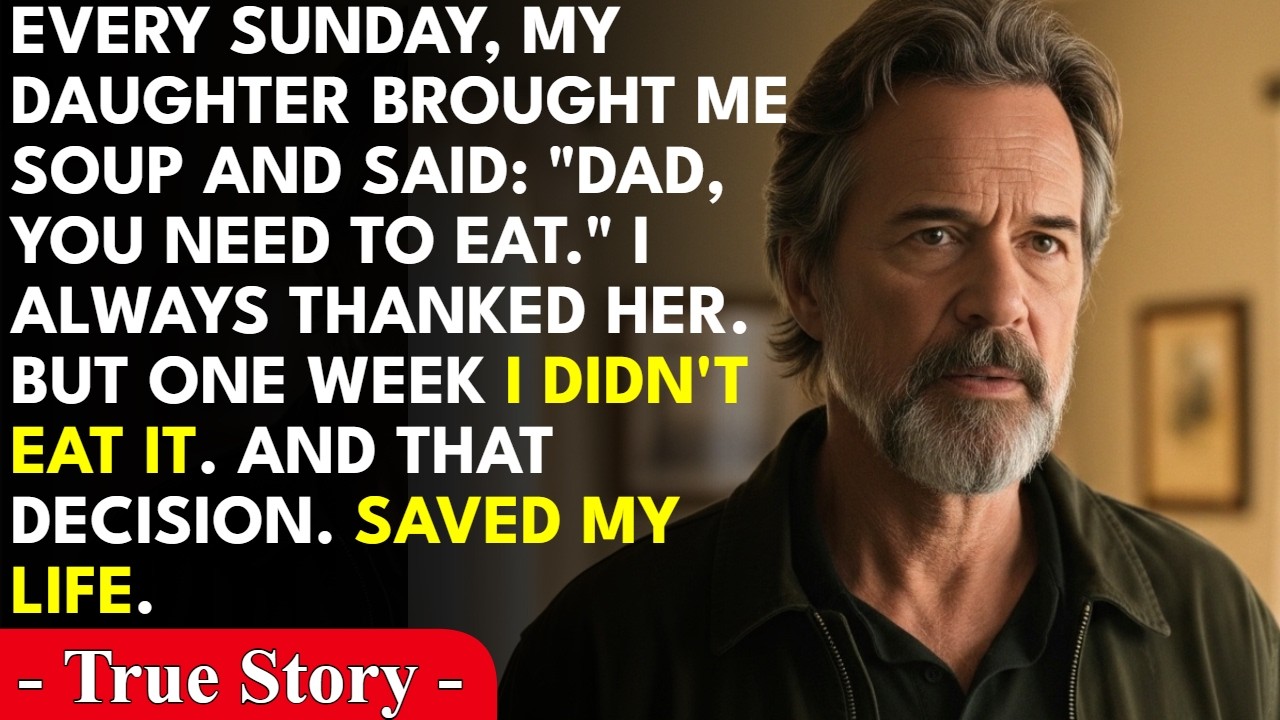
Not store-bought, not from a can. She made it herself. Chicken broth with thin noodles, a little parsley on top, the way her mother used to make it when I was sick. She’d drive forty minutes from her side of town, knock twice on my front door, and hand me a glass container still warm from her kitchen.
“Dad, you need to eat properly,” she’d say. And I’d take it, and I’d smile, and I’d mean it. This went on for almost two years after my wife passed. I want you to understand what those Sundays meant to me.
After Beverly died, after thirty-eight years of waking up next to the same woman, after learning how to make coffee for two and then suddenly having to relearn how to make it for one—those Sunday mornings were the thing that kept the week from collapsing in on itself. My daughter, Lee, would come in, set the soup on the counter, and sit with me for an hour. Sometimes two. We’d talk about nothing.
The neighbors, a show she was watching, the way the oak tree in my backyard was starting to lean toward the fence. Nothing important. Everything important. I was sixty-four years old, retired from twenty-two years at the county assessor’s office, living alone in the house in Millbrook where Lee and her brother had grown up.
My son, Colin, lived out in Phoenix. We talked on the phone every couple of weeks, but it wasn’t the same as having someone nearby. Lee was nearby. Lee showed up.
So when she started calling every few days to ask what I was eating—not just on Sundays, but Tuesday evenings, Thursday afternoons—I thought it was love. I thought she was worried about me the way children worry about a parent who’s been a little lost since losing their other parent. I thought I was lucky. “Dad, did you eat lunch today?
”
“Dad, are you making dinner or just having crackers again? ”
“I made extra soup this week. Can I drop some off Wednesday? ”
I always said yes.
Why wouldn’t I? The first time I felt something was wrong, I couldn’t name it. It was a Tuesday in late October, about fourteen months after Beverly died. I’d eaten the soup Lee had brought the day before, the one she said was a new recipe with lemon and orzo, and by evening I had a headache that pressed behind my eyes like something pushing from the inside.
I went to bed early. By morning it had faded, and I forgot about it. Two weeks later, same thing. Different soup, same headache.
I mentioned it to my doctor at my regular checkup. He asked about my sleep, my stress levels, whether I was drinking enough water. He adjusted one of my blood pressure medications. I went home and didn’t think about it again.
But the headaches kept coming. Not every week. Roughly once every two to three weeks. Always within twelve hours of eating Lee’s soup.
I didn’t connect those two things, not then. I was a grieving sixty-four-year-old man who’d had high blood pressure for a decade. There were plenty of reasons to feel unwell. What finally made me pay attention was my neighbor Dennis.
Dennis is seventy-one, a retired electrician who lives two houses down and has a habit of stopping by unannounced when he sees my truck in the driveway. He came over one afternoon in January and found me on the couch in a way that clearly concerned him. I was pale. I had that headache again, and I’d apparently slept for most of the day without realizing it.
He sat across from me and said bluntly, the way Dennis always says things, “You look terrible. And you looked this way last month, too. You need to go back to your doctor. ”
I told him I’d just eaten and felt off.
He looked at the empty container on my kitchen counter, the glass one Lee always used, and said, “That daughter of yours is here every week with that stuff. You’re not getting better. You’re getting worse. That mean anything to you?
”
It didn’t. Not yet. But I remembered what he said. In February, Lee mentioned, casually, in the way you mention things you don’t want to seem important, that she’d been looking into the cost of eventually putting the Millbrook house on the market.
“Not now, Dad. Just thinking ahead. Real estate in this area has really gone up. ”
I said I wasn’t interested in selling.
She dropped it. But two days later, she brought it up again in a slightly different way, asking whether I’d ever thought about moving somewhere smaller, easier to maintain. “You’re not getting any younger,” she said, and laughed like it was a joke. I’m not a suspicious man by nature.
I spent twenty-two years doing paperwork. I believe in straightforward explanations for things. But something about the combination—the property talk, the weekly soup, the headaches I couldn’t shake—settled into the back of my mind like a stone. In March, I had a conversation with my doctor that I’ve replayed many times since.
I’d gone in for a follow-up on the blood pressure medication. At the end of the appointment, almost as an afterthought, I mentioned that I’d been feeling foggy in a way that was hard to describe. Not forgetful, exactly. More like a slowness.
Like thinking through gauze. He ordered a blood panel. Routine, he said. Come back in two weeks.
The results showed elevated liver enzymes. Not dramatically elevated, but outside the normal range. He asked about my alcohol intake, which is minimal—two beers on a Friday night at most. He asked about supplements.
He asked if I’d started any new foods or changed my diet significantly. I said, “No. ”
He said, “We’ll monitor it. ”
I drove home and sat in my driveway for a long time.
The Sunday after that appointment, Lee brought soup. I thanked her. I set it on the counter. I waited until she left, and then I didn’t eat it.
I told myself I just wasn’t hungry. I made eggs instead. That week, no headache. I told myself it was a coincidence.
The following Sunday, she brought soup again. Again, I thanked her. Again, I set it aside. I told her I’d had a big lunch and would eat it later.
She watched me for a second—just a half second, really—and then smiled and said, “Of course. ”
That week, no headache. No foggy feeling. No pressing behind the eyes.
I slept through the night twice, which I hadn’t done in months. I sat at my kitchen table on a Thursday morning and stared at the glass container in my refrigerator for a long time. Then I picked up the phone and called Dennis. I didn’t tell him everything.
I barely had a shape for it yet myself. But I told him I needed a favor. I told him I needed someone to help me get something tested. He asked, “What kind of something?
”
I said I wasn’t sure yet, but that I needed to do it quietly, without making a phone call Lee might find out about. Dennis is not a man who asks a lot of follow-up questions when the tone of your voice tells him what he needs to know. He said, “Give me twenty-four hours. ”
He knew a woman who worked in a lab over in the next county.
Not a friend, exactly. More of an acquaintance from his electrician days. She’d worked in a medical testing facility, then moved on to an environmental lab. He drove the container over himself.
He said he told her it was a personal matter and that he’d owe her one. Five days later, I had results I didn’t know how to hold. There was a compound in the soup. A substance—I won’t use the technical name because I could never pronounce it correctly anyway—that at low doses, consumed over time, can cause fatigue, elevated liver enzymes, headaches, and a general cognitive slowing.
It’s not something you’d stumble into by accident. It’s not something that grows in chicken broth on its own. I sat in Dennis’s kitchen when he told me. I remember his kitchen table has a crack along one edge that his wife has been telling him to fix for years.
I stared at that crack for a long time. He said, “Do you want me to call someone? ”
I said, “Not yet. ”
I need you to understand something about what that moment felt like.
This was not a stranger. This was not someone who had come into my life and taken advantage of me. This was the girl I had taught to ride a bike in the same neighborhood. This was the person I’d driven to her prom, waited up for, walked down the aisle, been there for when her marriage started going wrong.
This was my daughter. And I sat in Dennis’s kitchen and felt something that I can only describe as the floor disappearing. I didn’t cry. I wanted to.
But I think I was too far inside the shock to get to the crying part. What I felt underneath the shock was something worse than anger. It was grief—a specific kind of grief. The kind where you lose someone who is still alive.
Where you have to go back through every memory and wonder what was real and what wasn’t. Where the person you loved and the person who hurt you are the same person, and you have no idea how to carry both of them at once. I drove home alone that night and sat in Beverly’s chair, the one by the window in the living room that I haven’t moved since she died, and I talked to her. I know how that sounds.
I don’t care. I told her what I’d found out. I asked her what she would do. I sat there until two in the morning, and I didn’t get an answer, but I felt less alone than I had since walking out of Dennis’s kitchen.
The next morning, I called a lawyer. Not to press charges—not yet—but to understand what I had and what my options were. Her name isn’t important. What matters is that she was methodical and calm, and she laid it out for me clearly.
What I had was a lab result and a pattern, not proof of intent—not yet. She said if I wanted to build something solid, I needed to document more. I needed to be careful. I needed, above all, not to let Lee know I was suspicious.
That last part was the hardest thing I have ever been asked to do. The following Sunday, Lee came with soup. I opened the door. I smiled.
I told her she was good to me. I set the soup on the counter and told her I was going to eat it for dinner. She sat with me for her usual hour. We talked about nothing.
The weather had been strange. There was a pothole on Clearwater Drive that had been there since December. She mentioned again that she’d been doing some research on senior living communities—not for now, just to have information—and asked if I’d be open to visiting one sometime. I said maybe someday.
When she left, I stood at the window and watched her car back out of the driveway. Then I took the soup and documented it. Date, time, container sealed in a bag. I brought it to Dennis the next morning.
I did this for three more Sundays. Every result came back the same. In the fifth week, the lawyer helped me bring what we had to the county sheriff’s office. I asked that it be handled quietly, and they obliged at first.
A detective came to my house—a calm, serious woman who sat at my kitchen table and listened without interrupting. She asked if my daughter had a financial motive. I told her about Beverly’s life insurance policy, which I had not yet touched. I told her about the house, the Millbrook house, which had appreciated significantly, and which, per Beverly’s will, was to go to Lee and Colin equally upon my death.
She nodded slowly. She asked if there was anything else. I told her about the phone calls, the property questions, the increasing frequency of the soup. She wrote everything down.
She said she would need a few days. Three days later, she called me back. In the course of their initial inquiry, they had pulled Lee’s financial records with a subpoena. My daughter was in significant debt.
Credit cards, a personal loan she had taken out eighteen months ago, and a second loan she had co-signed with her ex-husband that was now entirely her responsibility. The total was close to ninety thousand dollars. She had been making minimum payments on all of it. I sat down when the detective told me that number.
Ninety thousand dollars. I thought about the soup. I thought about forty minutes each way. Every Sunday, the glass container still warm.
I thought about whether she had started bringing it out of love, and then, somewhere in the darkness of her financial desperation, let something else in. Or whether it had been calculated from the beginning. I still don’t know the answer to that. I’m not sure I ever will.
They arrested her on a Wednesday afternoon. I was not present. I’d asked not to be told exactly when it would happen, only that it had happened. I didn’t think I could sit in this house knowing the exact minute.
The detective called me at 4:17 in the afternoon and said simply, “It’s done. ”
I sat in Beverly’s chair again. I thought about calling Colin, but I couldn’t find the words yet. I sat there until the sun went down and the room went dark, and I didn’t get up to turn on the lights.
Colin flew in from Phoenix four days later. He sat across from me at the kitchen table. The same table where the detective had sat. The same table where I had eaten thirty-eight years of ordinary dinners with Beverly, where Lee and Colin had done their homework and fought over the last biscuit and grown up.
And he looked at me the way a person looks at someone they’re not sure they recognize anymore. He said, “Dad, why didn’t you tell me sooner? ”
I said, “I didn’t know how. ”
He reached across the table and put his hand over mine and didn’t say anything else for a while.
That silence was the most comfort I’d received in months. Lee’s attorney entered a plea of not guilty. I won’t go into the legal details because they are still unfolding, and because I have been advised to keep my public statements limited. What I will tell you is that she did not get the house.
She did not get the insurance. What she got instead is something that will follow her for the rest of her life. And I’ve had to make peace with the fact that I am the person who set that in motion. Even though I know, rationally, that she set it in motion herself.
Making peace with something and being at peace with it are not the same thing. I want to be honest about that. What I keep coming back to, what I cannot stop turning over in my mind on the nights when I can’t sleep, is that she kept coming every Sunday. Week after week, she drove forty minutes, knocked twice, handed me the container still warm, sat with me for an hour, and talked about the weather and the pothole on Clearwater Drive.
I keep asking myself: what does a person feel when they do that? Was there love still in there somewhere, running alongside something I can’t name? Or had the love become something else entirely without her noticing? I don’t have an answer.
The people I’ve talked to since—the counselor I started seeing in April, the pastor at my church, Dennis, who has been more steadfast than any neighbor has any obligation to be—none of them have an answer, either. They have kindness, which is different. What I’ve learned, what I want to say to anyone watching this who has a parent living alone, or who is a parent living alone, is that isolation creates vulnerability in ways we don’t fully understand until we’re inside it. After Beverly died, I closed some part of myself off without realizing it.
I stopped trusting my own instincts because grief had made those instincts unreliable. I told myself the headaches were blood pressure, the fog was age, the weariness was loss. I explained everything away with the nearest reasonable explanation, and I nearly paid for it with my life. Listen to your body.
Listen to the parts of your mind that notice things even when you’re not ready to look at what they’re noticing. Dennis knocked on my door. That matters. He showed up at the right time, the way good neighbors do without knowing they’re doing it, and he said the plain thing out loud that I hadn’t let myself think yet.
I don’t know where I would be right now if he hadn’t come over that afternoon and found me pale on the couch and said bluntly that I looked terrible. I still live in Millbrook. I still sit in Beverly’s chair by the window. I did eventually get the lights fixed in the backyard, the ones that had been flickering since last fall.
And sometimes in the evenings I sit on the back step and watch the oak tree, the one that’s leaning toward the fence, and I feel something that isn’t happiness exactly, but is in the same neighborhood as it. Colin calls twice a week now, not twice a month. He calls. Not the checking-in kind, but the talking kind.
Where we stay on the phone past the point of anything useful to say. I’ve started telling him about my days in more detail than I used to. He started doing the same. We’re learning to know each other in a way we should have started years ago.
I’m not going to tell you that something good came out of what happened. I don’t believe in that framing. What happened was a loss. The loss of the person I thought my daughter was.
Or maybe the loss of the person she used to be. Or maybe something that was never quite as solid as I believed it was. That loss is real. It doesn’t become a lesson.
It stays a loss. But I’m still here. That’s not nothing. I’ve thought a lot about the word care.
How it sounds, how it feels when someone uses it on you. Lee used it constantly. “I just care about you, Dad. I worry about you, Dad.
You’re not getting any younger, Dad. ” And I believed her because I wanted to. Because grief had already taken so much from me, and I wasn’t willing to let it take that, too. But here’s what I’ve had to learn the hard way.
At sixty-four, in a house that still smells faintly like Beverly’s hand lotion, care is not a word. It’s a pattern. It’s what someone does on the Tuesday when there’s nothing in it for them. It’s Dennis showing up unannounced because my truck was in the driveway and something in his gut said to knock.
That’s care. It doesn’t announce itself. It just shows up. What Lee showed up with for two years looked like care.
Had the shape of it, the warmth of it. And I think that’s the thing that still sits heaviest with me. Not the betrayal itself, but how well it was costumed. How easily I wore the costume, too, because I needed something to hold on to after Beverly, and a daughter who brought soup every Sunday felt like something solid in a season where nothing was solid anymore.
The consequences that found Lee were not ones I chose exactly. Or maybe I did choose them—in the slow, methodical way I documented each container, drove to Dennis’s house, sat across from a detective at my own kitchen table. Every step was a choice. I want to own that.
I didn’t stumble into the truth. I went looking for it once I could no longer afford to look away. And the truth, once I had it, demanded something of me. That’s how it always works.
You can’t unknow a thing. You can only decide what to do with the knowing. What I want to say to anyone listening, especially if you’re living alone, especially if you’re in that specific kind of fog that grief wraps around you like a second skin, is that your instincts are not broken, even when grief makes them feel unreliable. My body told me something was wrong for months before my mind was ready to hear it.
The headaches, the fog, the days I slept until three in the afternoon and told myself it was age. My body was right. I was just too willing to explain it away. Pay attention to the things you explain away.
And if you have a Dennis in your life—someone plain-spoken and steady who shows up without an agenda—hold on to that person. Tell them you’re grateful. That kind of loyalty doesn’t require soup. It doesn’t require anything except showing up.
And it’s rarer than we pretend. I’m still in Millbrook. Colin calls twice a week now. The oak tree is still leaning toward the fence, and I keep meaning to deal with it.
And I probably won’t. Some things you just learn to live alongside. I’m still here. That’s where I start every morning now.
Still here. And from that, I can build the rest of the day.