They didn’t think I was listening. That was their first mistake. My son-in-law, Jake, had a way of talking about me like I wasn’t in the room. Even when I was sitting right there at the kitchen table, coffee in hand, he’d lean over to my daughter, Claire, and say things just loud enough for me to catch.
He doesn’t understand how money works anymore. He’s getting forgetful. Someone needs to be in charge before it’s too late. I never said anything.
I just sipped my coffee. My name is Walter. I’m sixty-seven. I spent thirty-one years as an electrician, then another twelve running a small contracting business out of a shop I built myself on the back of my property.
I drive a ten-year-old pickup with a dent above the left rear wheel well I never got around to fixing. I wear the same three flannel shirts in rotation from October through March. I cut my own grass and cook my own meals. On Sunday mornings I read the paper on the porch before anyone else in the neighborhood is awake.
To look at me, you’d think I was exactly what Jake thought I was. A tired old man coasting toward the end. That was his second mistake. I’d lived in my house for twenty-two years.
I bought it when Claire was in middle school, right after her mother passed. A modest place, three bedrooms, a big backyard, a detached garage I converted into a workshop. Nothing fancy, but I owned it outright. Paid off the mortgage eleven years ago and never looked back.
My name was on the deed, on the insurance, on the utility accounts. Every piece of paper connected to that house had one name on it. Mine. Claire met Jake when she was twenty-eight.
He was charming in the way certain men are charming. Loud at dinner parties. Quick with a compliment. Always the one who picked up the check when other people were watching.
I noticed early on that he never picked it up when no one was looking. But Claire loved him, and she was happy, so I kept my observations to myself. They married three years ago. Jake had a decent job in sales, but he also had expensive taste.
A new car every two years. Vacations that showed up on Instagram before he’d even unpacked. I watched all of it without comment. My daughter was an adult.
It wasn’t my place. They were renting an apartment in the city when Jake lost his job. That was about eighteen months ago. He told people he’d left voluntarily, that he was pursuing other opportunities, but I’d heard from a former neighbor who worked in his building that it hadn’t been voluntary at all.
Again, I said nothing. I just noted it quietly, the way I noted most things. When Claire called to say they were struggling with rent, I offered what I thought was a simple solution. They could come stay with me.
I had the space. The second bedroom was just sitting empty. I told her it would only be temporary, just until Jake got back on his feet, and that I wasn’t going to charge them anything. I made one request, just one.
That they treat the house with respect. That they understand it was my home, not theirs. Claire said, Of course, Dad. Of course.
They moved in on a Saturday in March. By the following Tuesday, Jake had rearranged the living room furniture without asking. I moved it back. He rearranged it again.
I moved it back again. He looked at me like I was being difficult. I looked at him like he was sleeping in my house for free. That was more or less how the next six months went.
The small things accumulated the way small things do. Jake would turn the thermostat up while I was standing right next to it. He’d invite friends over on weeknights without mentioning it. He ate the leftovers I’d labeled in the fridge and replaced them with takeout containers he never threw away.
Claire apologized for him constantly, in that quiet, apologetic way she’d developed over years of being married to someone who never apologized for himself. I could manage small things. I’d managed harder things than that. I kept to myself, worked in my shop in the mornings, had dinner at my own table at my own hour.
I was patient. I genuinely believed the situation was temporary. Then came the conversation that changed everything. I came in from the workshop one evening in September and found Jake sitting at my kitchen table with a folder of papers spread out in front of him.
Claire was beside him with an expression I didn’t like at all. The look of someone who’s been practicing what to say and still isn’t sure she’s ready to say it. Jake told me to sit down. He said that in my own kitchen.
“Walter, sit down. We need to talk about some things. ”
I sat, not because he told me to, but because I was curious. He started with what he called a practical conversation.
He said that he and Claire had been looking at the financial picture. That they were thinking about long-term stability. That they had some ideas about how to restructure things in a way that would benefit everyone. He used the word restructure three times in the first two minutes.
I counted. Then he got to the point. He wanted me to sign a document giving him and Claire shared power of attorney over my finances and property. He framed it as a safety net.
A way to make sure everything was in order in case something happened to me. He slid a paper across the table and told me his brother-in-law had drawn it up. That it was very standard. That a lot of older people did this kind of thing.
I looked at the paper. I didn’t pick it up. I looked at Claire, who was studying the table. Then I looked back at Jake.
I asked if I could have some time to review it. He smiled and said, “Of course. Take all the time you need. ”
I took the paper to my workshop, closed the door, and read every line three times.
Then I called the one person I always called when something required careful thought. My old friend Dennis, who’d been a real estate attorney for thirty years before retiring to a house two counties over. Dennis read what I photographed and sent him. He called back in twenty minutes.
His voice was very steady. He told me this document, as written, would give Jake and Claire legal authority to make financial and property decisions on my behalf. Including decisions about my house. Including the ability to initiate a sale.
He asked if I had any intention of signing it. I told him I had not. He said, “Good. ”
He also said something I kept coming back to in the days that followed.
“Walter, if someone is asking you to sign something like this, it’s worth asking yourself what they believe they’re going to do with it. ”
I went back inside and told Jake I needed more time. He nodded. The smile didn’t quite reach his eyes.
Over the next few weeks, I paid close attention to things I’d previously ignored. Jake was on his phone constantly, but he angled the screen away when I entered the room. He had a habit of going quiet mid-sentence when he realized I’d walked in. One afternoon I came in from the garage and caught the tail end of a conversation, something about square footage, something about market value.
He saw me and said he was talking to a friend about real estate in general. I said that was interesting and went to make myself a sandwich. I’d already started making some phone calls of my own. What I’d never mentioned to anyone in that house was that my contracting business had done reasonably well.
Not wealthy by television standards, but the kind of wealth that doesn’t announce itself. I had savings. I had investments managed by a woman named Patricia, who’d been handling my accounts for nine years. And I had, at Dennis’s recommendation several years prior, already placed my property into a revocable living trust.
My name was the trustee. The house could not be signed away without going through the trust. A power of attorney of the type Jake had drawn up would have done very little, legally, to give him what he was after. I’d never told Jake any of this.
I’d never told Claire, either, because Claire told Jake everything. It was Dennis who suggested I start documenting things. Dates. Conversations.
Observations. He also suggested I speak with an elder law attorney, just to make sure my protections were airtight. I did. Her name was Margaret, and after our first meeting she told me my situation was more secure than I’d realized, but that my instincts were right.
Something was being planned. In November, Jake told me his parents needed a place to stay. His father had health issues, he said. Their rental wasn’t working out.
He presented it the way he presented most things, as something already decided, something I just needed to agree to. He wanted to convert my workshop into a guest suite for them. My workshop. The space I’d built with my own hands.
Where I kept my tools, my drafting table, my files. The place I went every morning for thirty years because it was the one place in the world that was entirely mine. I was quiet for a long moment. Then I said, “I’d think about it.
”
That night I called Dennis again. Then Patricia. Then I sat in the workshop for a long time with the lights on, looking at the walls. Two days later, Jake came to me with a printed estimate from a contractor for the workshop conversion.
He’d already gotten an estimate. He hadn’t asked me. He’d gotten an estimate. I told him I hadn’t agreed to anything.
He said he was just being proactive. I said the conversation was over and went to bed. The following weekend, while I was out at the hardware store, his parents arrived. I pulled into the driveway and there was a moving truck.
Not a big one, but a truck. Claire met me at the door with the expression I’d come to think of as her apology face. The one that meant she already knew this was wrong and had done it anyway. She said they’d just be staying in the second bedroom temporarily while the workshop was being prepared.
I stood in my own driveway for a moment and looked at the truck, looked at my daughter, looked at the house I’d owned for twenty-two years. Then I said, “Okay. ” And I went inside and called Dennis. Here’s what I want you to understand about the three months that followed.
I did not argue. I did not threaten. I did not raise my voice. I went about my life with the same steadiness I’d always had.
I ate my meals. I tended my yard. I visited my workshop even though there were boxes stacked in the corner now that didn’t belong to me. I was polite to Jake’s parents, who weren’t unkind people.
Just people who’d been told a version of the situation that left out several important details. But I was also working. Dennis connected me with a property manager he trusted, a woman named Sylvia who’d been in residential real estate for twenty years. I met with her twice quietly at her office downtown.
I told her my situation. She told me my options. My house, in the current market, was worth considerably more than I’d expected. The neighborhood had appreciated substantially in the past decade.
I instructed Sylvia to begin the process. Margaret updated my trust documents. Patricia reviewed my accounts. Dennis reviewed everything twice.
I did not tell Claire. I did not tell Jake. I did not tell a single person inside that house what was happening. In January, I accepted an offer.
A young couple, a teacher and a physical therapist, who’d been looking in the neighborhood for two years. They were exactly the kind of people I wanted in the neighborhood. Sylvia told me they planned to take good care of the property. I believed her.
The closing was scheduled for the last Friday in February. I want to tell you about the Thursday before closing, because that was the day everything came into the open. Jake came home that afternoon in a different kind of mood than usual. He sat down in the living room and looked at me with an expression I hadn’t seen before.
Something between anger and calculation. He said he’d been talking to a real estate agent of his own. That he’d had someone informally assess the property. That he was aware the market was strong right now.
He said it carefully. He was watching my face. He told me he and Claire had been thinking about their future. That it made more sense financially for the family, he used the word family, to hold on to a property like this rather than have it sitting in my name doing nothing.
Doing nothing. That was the phrase he used. About the house I’d paid off with thirty-one years of physical labor. He said he thought it was time to move forward with that power of attorney conversation.
He slid another copy of the document across the coffee table. A clean copy. He’d been keeping a clean copy ready. I looked at him for a moment.
Then I looked at the document. Then I looked at him again. I said, “Jake, I need to tell you something. ”
He leaned back a little, ready to manage me.
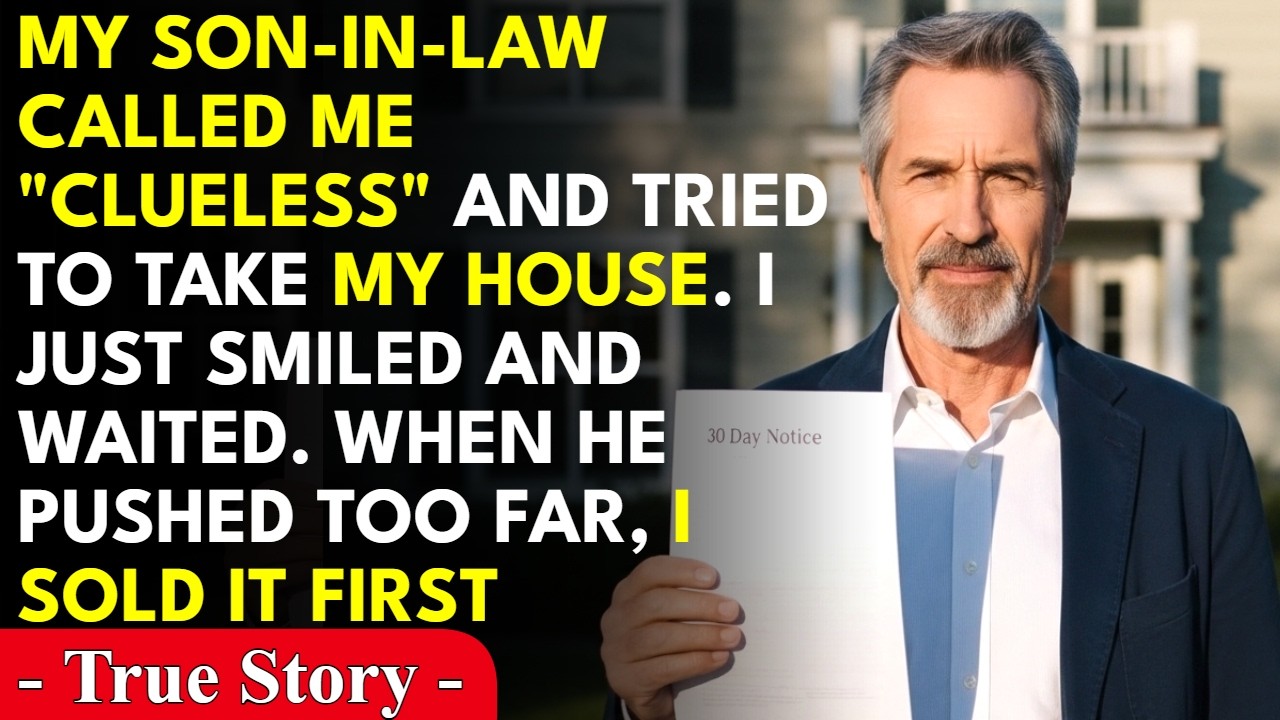
I told him I’d spoken with an attorney several weeks ago. That I’d reviewed my options carefully. That I’d taken steps I felt were appropriate to protect my interests. And that as a result, I had accepted an offer on the house.
The room got very quiet. I told him the closing was tomorrow. That the new owners would take possession in thirty days. And that per the terms of the sale, all current occupants would need to vacate the property within that thirty-day window.
He didn’t move for a long moment. Then he said something. I don’t remember exactly what. Something about how I couldn’t do that.
How there were people living here. How this wasn’t just my decision to make anymore. I told him very calmly that he was mistaken. That my name was on the deed.
That the property was held in my trust. That I’d signed a valid purchase agreement with qualified buyers. And that everything had been reviewed by two attorneys. He stood up.
His face had changed. All the smooth salesmanship was gone, and there was something raw underneath it. He said I was making a mistake. He said this would affect his family.
He said I was being selfish. I thought about the workshop. The furniture he’d rearranged without asking. The refrigerator, the thermostat, the moving truck in my driveway, the clean copy of the power of attorney he’d been keeping ready.
I said, “Jake, I think we see this situation very differently. ”
Then I went to bed. Closing happened the next morning at nine. I sat across the table from the teacher and the physical therapist, who were nervous and happy in the way people are when something important is finally happening.
I signed my name in twelve places. Sylvia squeezed my arm on the way out. Dennis met me for lunch afterward, and we talked about everything except what had just happened. Which was exactly what I needed.
I’d arranged to stay with a friend, a retired colleague named Raymond, for the duration of the thirty days while I finalized other plans. I’d already put a deposit on a smaller property, twenty minutes outside the city. A two-bedroom place with a good-sized lot where I intended to build another workshop. I’d been looking at it for six months.
I’d simply been waiting. Back at the house, the thirty days were not peaceful ones for Jake. I know this because Claire called me twice during that period. Not to argue, but to talk.
The real Claire. The one underneath the apologetic face. She told me she’d known something was wrong for a long time. That Jake had told her things about my situation she’d later realized weren’t true.
That she was sorry. I told her the door was always open to her. That I loved her. That this was never about her.
She cried a little. I waited. She asked where I was going to live. I told her about the new place.
I described the lot, the plans for the workshop. She said it sounded like me. It did. Jake’s parents moved out two weeks before the deadline.
Jake and Claire moved into a small apartment on the other side of the city. The teacher and the physical therapist took possession of the house on the first of March, exactly as scheduled. I drove by once a few weeks later, not to look at the house, but because the road went that direction. The porch light was on.
There were boots by the front door and a bicycle locked to the railing. Someone was taking good care of it. I moved into the new place on a Thursday. Raymond helped me carry boxes.
It took most of the day because I had more books than either of us expected. By evening we had the kitchen mostly set up, and we sat on the back porch with two cold beers and looked out at the lot. Raymond said, “So, what are you going to do with all this space? ”
I said I was going to build a workshop.
He laughed. He asked if I needed help. I said I’d let him know when the framing was ready. People ask me sometimes if I regret how things went.
Whether I could have handled it differently. Talked to Jake sooner. Confronted Claire earlier. Avoided the whole thing.
I think about it. I genuinely do. But here’s what I come back to every time. I was never confused about what Jake wanted.
The confusion was his, about what I was. About what I had. About what I would and wouldn’t do. He looked at a man in a flannel shirt driving a dented pickup truck and he made a decision about who that man was.
He built a plan around that decision. He kept a clean copy of a document ready on the assumption I’d eventually just sign it. He never once considered that the quiet man at the kitchen table might have his own attorney. His own trust.
His own plan. That’s the thing about underestimating someone. You stop paying attention to them. And people who are not being watched have a great deal of freedom to act.
I have my new workshop now. It took me four months to build it the way I wanted. I did most of the framing myself. Hired out the electrical to a young guy I knew from the trade who needed the work.
The walls are lined with pegboard, and everything has its place. There’s a drafting table in the corner where my plans go. There’s a window that looks out at the back field. I go out there every morning before anyone else in the neighborhood is awake.
I make my coffee. I sit at the drafting table. I look out the window.
And I think about what I want to build next.