You sat in your living room one evening, the weight of the quiet pressing down on you, and you asked yourself the question that had been circling your mind for months: how did your relationship with your child come to this? You raised them. You sacrificed for them. You gave them everything you had.
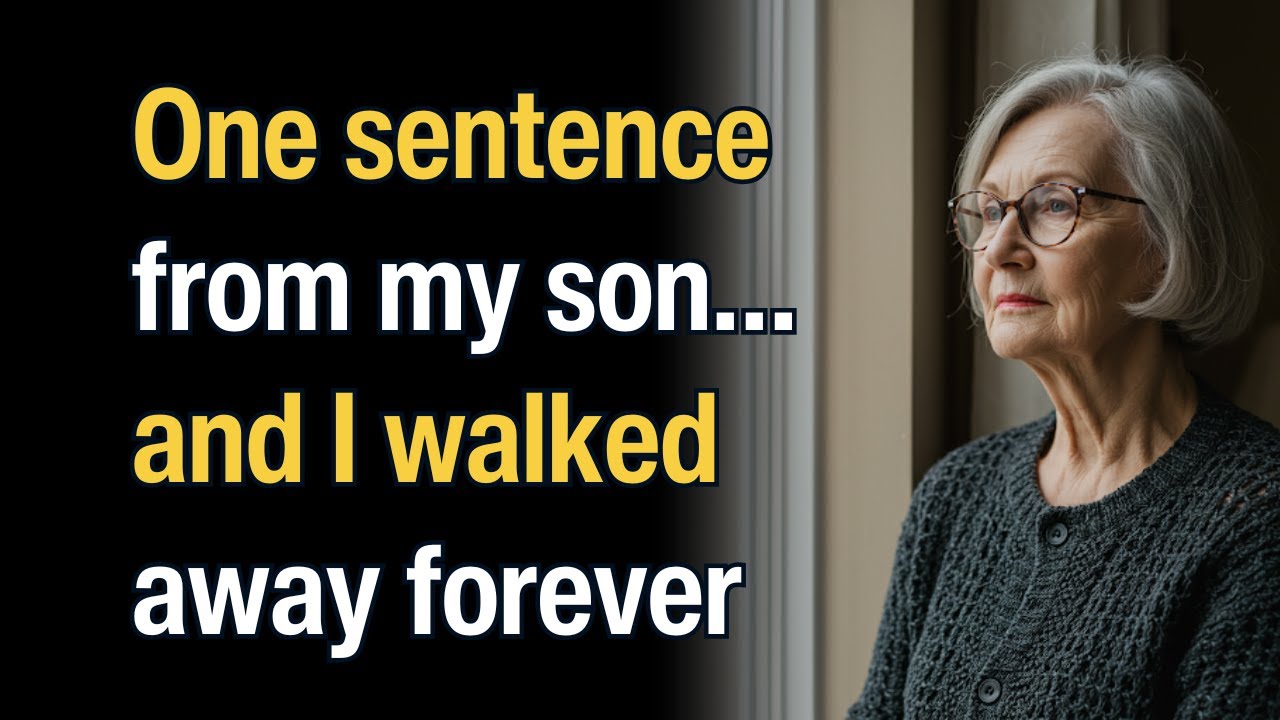
And now, years later, what comes back to you is silence, sharp words, or a heaviness in your chest that never quite lifts. If that sounds familiar, you are not alone. Plenty of parents over sixty carry this same quiet burden, trying to make sense of a bond that no longer feels loving or safe. You walk on eggshells around the person you once cradled in your arms.
You wonder if speaking up will only push them further away. And somewhere deep down, you question whether love is supposed to feel this strained, this one-sided, this painful. Here is the truth: as you get older, your peace becomes more precious than anything else. You do not have time for guilt trips or emotional games.
You deserve relationships that nourish your heart, not ones that quietly break it. There are certain phrases that, when spoken by your adult child, may be the clearest sign that it is time to step back. These are not small misunderstandings or simple differences in personality. These are words that reveal a deep lack of respect, emotional manipulation, or a refusal to grow.
When these phrases keep showing up, it may be time to protect your heart and create distance. And before going further, understand this: setting boundaries does not mean you failed as a parent. It does not mean you have stopped loving them. It means you love yourself enough to say this is not okay.
One of the most painful things a parent can hear is, you were never there for me. At first, it hits like a punch to the gut. You want to argue. You want to defend yourself, replaying all the nights you stayed up waiting for them, the lunches you packed, the jobs you worked, the tears you shed when they were hurting.
You were there. Maybe not perfectly, but you showed up the best way you knew how. Now, it is one thing for a child to express painful feelings as part of healing. That is understandable.
But when this phrase is repeated over and over, not to connect but to wound, it becomes emotional blackmail. It keeps you small, guilty, and forever indebted. It erases every effort you made and paints you as the villain in a story you never asked to be in. And no matter what you do to make up for it, it is never enough.
The more you give, the more they take, and the more they remind you of how much you supposedly failed. That is not a relationship. That is punishment. If this phrase keeps coming up wrapped in blame rather than a desire to heal, ask yourself: are they looking for connection or control?
You can apologize once. You can express your love. But you do not owe your life to a version of the past that only exists in their mind. If they are not willing to see your humanity, your sacrifices, and your current efforts, then they are not trying to build a relationship.
They are trying to dominate one. And that is not love. Then there is the phrase that sounds casual at first but carries real weight: that’s just how I am. Deal with it.
Maybe you tried to talk to your child about the way they speak to you, the way they disappear for months, the way they snap at you over the smallest things. You expressed how it hurt. You tried to open up. And all you got in return was, well, that’s just who I am.
That is not honesty. That is not self-awareness. That is emotional laziness. It is a refusal to reflect, to grow, or to even consider that their behavior is hurting you.
In any healthy adult relationship, growth is part of the deal. We do not stop evolving because we turn thirty or forty or sixty. We keep learning. We keep adjusting.
We try to do better. When someone says, that’s just how I am, what they are really saying is, I do not care how my actions affect you. And that is not acceptable. Not from anyone.
Especially not from someone you have loved and supported for decades. You might have told yourself that they have had a hard life, or they do not know how to express themselves, or they are going through something. All of that might be true. But it does not excuse cruelty.
It does not excuse disrespect. If someone is old enough to say, that’s just how I am, they are old enough to understand that relationships require effort. You are not asking for perfection. You are asking for kindness.
And if they cannot give that, or worse, refuse to try, it is okay to say, I love you, but I will not accept this. That does not make you cold. That makes you wise. When people care about you, they care about how they make you feel.
Even when they mess up, even when they do not know how to fix it, they try. And that effort means everything. Now there is a phrase that can leave you both confused and deeply wounded: I don’t owe you anything. It is hard to even imagine a child looking at the person who fed them, clothed them, sacrificed for them, and saying those words.
That kind of statement cuts right through the heart. Let it be clear: children do not owe their parents for being born. We do not bring children into the world expecting a return on investment. But what they do owe, like all people, is basic human decency.
They owe respect. They owe gratitude. They owe a willingness to see you not just as mom or dad, but as a person, a person who loved them the best way they knew how. When your adult child says, I don’t owe you anything, it is usually not about independence.
It is about dismissing the entire relationship. It is a way to shut you down, silence your feelings, and avoid responsibility for how they treat you. You are not asking for a medal. You are asking for mutual respect.
And if that is too much for them, you have every right to take a step back and say, if this is how you speak to me, then I need some distance. Love without respect is not love. It is control. And you deserve better.
This is heavy. If you are feeling emotional right now, that is completely understandable. These are not easy things to hear or think about, especially when they involve people we love more than anything. But as hard as this is, it is also an act of strength, of clarity, of reclaiming your worth in a season of life where your heart deserves peace, not pain.
Sometimes the most painful part is not just the words themselves. It is the realization that someone you gave your life to, someone whose birthday you never forgot, whose scraped knees you once kissed, whose tears you wiped, can speak to you like a stranger. Or worse, like you are a burden. That brings us to another phrase far more common than people like to admit.
It is subtle, but it carries a sting that lingers: you’re too sensitive. You may have heard this when you tried to express a feeling. Maybe something they said or did hurt you. Maybe you just needed to be heard.
Not judged. Not fixed. Just heard. And instead of listening with compassion, they shrugged and tossed your pain aside with those three words.
You’re too sensitive. Let us call this what it is: emotional dismissal. It is not just about the words. It is about what those words are used for.
They invalidate how you feel, make you question your reality, and shift the blame away from their behavior and onto your emotions. And when this phrase is used often enough, a dangerous pattern takes hold. You start to silence yourself. You stop bringing things up.
You begin to doubt whether your hurt is even valid. You start walking on eggshells around your own child, worried that anything you say will lead to criticism or coldness. That is not communication. That is control through gaslighting.
Because when someone tells you your emotions are too much, what they are really saying is, your boundaries make me uncomfortable. Now, this does not mean we should never self-reflect. Of course not. All of us, no matter our age, should be open to growing, to learning how to express ourselves better.
But there is a difference between self-reflection and self-erasure. And too often, when you are told you are too sensitive, you are being pushed to erase your feelings just to keep the peace. Sensitivity is not weakness. It is awareness.
It is empathy. It is what makes you human. And if someone in your life, especially your own child, cannot make space for your emotions, then it may be time to take a step back and protect your heart. Then there is the phrase that feels like it comes out of nowhere, but once said, leaves a crack that is hard to mend: I didn’t ask to be born.
Some parents hear this during a heated argument or in a moment when they have tried to set a simple boundary. It is one of those phrases that hits like a slap. It strips away your love, your care, your effort, and reduces it to an accusation. For so many of you, becoming a parent was not just a chapter in your life.
It was your life. You worked long hours. You skipped vacations. You lost sleep.
You said no to yourself so you could say yes to them. You did your best. Maybe not perfectly, but with every ounce of love you had. So when your child throws that line at you, I didn’t ask to be born, it is not just hurtful.
It is unfair. It is a way of making you responsible for every discomfort or disappointment in their adult life. It erases their responsibility and places all the weight on your shoulders, no matter how old they are or how many chances they have had to make different choices. You do not deserve to be blamed for someone else’s refusal to take ownership of their life.
We all start somewhere. And yes, maybe your parenting had flaws. Every parent has regrets. But being born is not a trauma you caused.
It is a gift. Even if your child has not learned how to see it that way yet, you do not have to accept this emotional rewriting of history. You are allowed to say, I did the best I could with what I had. If you want to talk about the past, let’s do it with respect.
But I will not be shamed for giving you life. And if that kind of respectful conversation cannot happen, if every attempt you make is met with sarcasm, blame, or emotional attacks, then it is okay to step back. It is okay to stop explaining yourself to someone who has already decided you are the villain. There is one more phrase that needs to be talked about, and this one can be tricky because it does not always come out sounding harsh.
Sometimes it comes wrapped in silence, in distance, in neglect. It is not always spoken directly, but it is felt in every unreturned call, every missed holiday, every cold shoulder. It is this unspoken message: you don’t matter unless I need something. That one breaks hearts quietly.
You see it when your child only calls when they want money or help with the kids or support during a crisis. But when you need something, even just a little company, a ride to the doctor, a birthday phone call, they are suddenly too busy, too tired, too distracted. Over time, you start to realize the relationship only flows in one direction. You give.
They take. And when you are empty, they disappear. Some of you have spent years trying to earn love from a child who only sees your value when they benefit from it. You have bought gifts, sent cards, offered rides, babysat grandchildren, all in the hopes that maybe this time it will build a real connection.
But love that only shows up when it is convenient is not love. It is a transaction. And you were not put on this earth to be someone’s emotional ATM. A relationship with your child should not require you to constantly prove your worth.
Your worth does not depend on how much you can do for others. You are allowed to say no. You are allowed to rest. You are allowed to have needs.
You are allowed to stop showing up for someone who never shows up for you. This does not mean you stop loving them. But it may mean you start loving yourself enough to say, I deserve more than this. And that brings us to the final phrase, perhaps the most subtle, but also the most dangerous: you owe me.
This one does not always sound the same. It can come dressed up in guilt trips, passive-aggressive remarks, or emotional debts that keep growing no matter how much you have already given. Maybe it sounds like, after everything I’ve been through, the least you can do is, or you’re my parent, isn’t that your job? And suddenly, you are not just their mother or father.
You are their lifetime servant, their emotional safety net, their built-in support system, no questions asked. No matter your age. No matter your needs. No matter how tired you are.
The idea that you owe your adult child anything beyond love, respect, and honest communication is deeply toxic. It creates an unbalanced dynamic where you are always giving and they are always taking. And when you finally set a limit, suddenly you are the bad guy, the selfish one, the ungrateful parent. Parenting is not a life sentence of emotional servitude.
Yes, we give to our children, often more than we give ourselves. But once they become adults, the relationship must evolve. It must shift from dependency to mutual respect, from obligation to appreciation, from demand to dialogue. If your adult child believes you owe them your money, your time, your space, your silence, without ever considering your well-being, that is not love.
That is entitlement. And it is not your responsibility to carry that. You are allowed to say no. You are allowed to say, I’ve done enough.
You are allowed to say, I love you, but I will not be used. Some people say family is forever. And yes, blood may be forever. But peace, that is something you have to choose and protect, even from the people you love most.
Sometimes walking away, whether physically, emotionally, or spiritually, is the most loving thing you can do for yourself. Love without boundaries is not love. It is survival. And you were not meant to merely survive.
Not at this stage in your life. Not after everything you have already endured. You were meant to thrive. To feel free in your own home.
To wake up with lightness in your heart. To know that your voice matters, your boundaries matter, and your peace is sacred. For so many people in your generation, love was always tied to sacrifice. You were taught to give until it hurt.
To put others first. To hold your tongue and keep the family together, even if it was breaking you in the process. But just because that is how things were does not mean that is how they have to be now. You have earned the right to protect your peace.
You have earned the right to say, I will not be disrespected. You have earned the right to love your adult child and still walk away from behavior that chips away at your spirit. And yes, it might hurt. It might feel unnatural at first.
You may even second-guess yourself. But remember this: setting a boundary is not the end of a relationship. It is the beginning of truth within it. And if your child ever chooses to come back with respect, with accountability, with a willingness to grow, you will be there with open arms and a heart full of love.
But not with the same silence. Not with the same self-sacrifice. This time it will be different. This time it will be mutual, because you now know what it means to value yourself.
If you have experienced even one of these phrases, if you have felt small, erased, used, or unloved by your own child, know that you are not alone. There are so many people walking this same quiet road, carrying the same quiet ache and the courage to speak about it, to seek support, to say this is not okay. That courage is a beautiful beginning. Maybe your child will change.
Maybe they will not. But either way, you are not powerless. You still have choices. You still have worth.
You still deserve peace. And peace is not selfish. Peace is survival with dignity. Peace is where healing begins.
If you have been waiting for a sign, this is it. Not a sign to stop loving your child, but a sign to start loving yourself just as fiercely. Your value does not come from what you give. Your worth does not depend on how others treat you.
Your heart, your wisdom, your story, they matter. So take that step, even if it is small. Maybe it is saying no to the next demand. Maybe it is writing a letter you do not send.
Maybe it is sitting in stillness and reminding yourself that you have done enough. You are enough.